
Car Ownership
When Fuel Costs Rise: Should You Keep or Sell Your Car in the Philippines?
Illustrative budget review with blank receipts; no actual fuel prices, customer records or savings are shown.
A higher fuel bill is a reason to review your car budget. It is not enough, by itself, to show that replacing the car will save money. Compare the extra fuel expense with the purchase gap, financing, other running costs and how well each option meets your transport needs.
Use current prices from your own location and dated quotations. This guide does not say fuel prices are rising everywhere today. Its examples are hypothetical calculations to help you decide what to check before keeping, replacing or selling without a replacement.
1. Measure the change in your own fuel bill
Record the distance you drive, litres purchased and price per litre over a consistent period. Separate a price change from a change in distance or consumption: spending more because you drove farther is different from paying more for the same journey.
For petrol or diesel, estimated monthly fuel cost = monthly kilometres ÷ kilometres per litre × price per litre. Use a realistic consumption figure for your driving, rather than assuming a road-test result applies to every route.
Suppose you drive 1,000 km per month at 10 km/L. You use an estimated 100 litres. At a hypothetical ₱60/L, that costs ₱6,000; at ₱70/L, it costs ₱7,000. The increase is ₱1,000 a month for the same distance and consumption—not a forecast of the next price adjustment.
Check the price at your station for the fuel grade you use. The Department of Energy’s fuel-price information provides an official reference point; record the date and location of any figure you put into your budget.
2. Compare the full keep-versus-replace decision
Choose the same future period for both options. Include energy, insurance, registration-related costs, maintenance, likely repairs, parking and tolls. Obtain quotations for known work rather than assuming every older car will become expensive or every newer one will be trouble-free.
For keeping the car, estimate its current sale value and possible value at the end of that period. The difference is the vehicle value you expect to use up. For a replacement, compare its purchase price with its possible future sale value, then add relevant running and changeover costs.
Future resale values are uncertain assumptions. Keep them labelled and try a less favourable scenario. The money you paid years ago is not the current cash cost of keeping the car, although today’s vehicle value matters when comparing the options.
Also check immediate cash needs. Buying the replacement may require money before its lower running costs can help. Do not count the full purchase price and depreciation together, or include loan principal twice. Our ownership-cost guide explains those distinctions.
A hypothetical three-year comparison
The following invented example assumes both cars are owned outright, any replacement is bought for cash, and the owner drives 1,000 km every month for 36 months. No interest, investment return or unexpected major repair is included. These are not quotes for any named model.
Fuel is assumed to stay at ₱70/L. The current car is assumed to achieve 10 km/L, costing ₱7,000 a month; the replacement 14 km/L, costing ₱5,000. Other running expenses average ₱3,000 and ₱2,000 a month respectively. Actual annual bills need their own payment dates.
Hypothetical 36-month comparison: Current vehicle value / replacement purchase price
Keep current car: ₱600,000
Buy replacement: ₱800,000
Hypothetical 36-month comparison: Assumed value after 36 months
Keep current car: ₱400,000
Buy replacement: ₱500,000
Hypothetical 36-month comparison: Vehicle value used up (first row minus second)
Keep current car: ₱200,000
Buy replacement: ₱300,000
Hypothetical 36-month comparison: Running expenses over 36 months
Keep current car: ₱360,000
Buy replacement: ₱252,000
Hypothetical 36-month comparison: One-off changeover costs
Keep current car: ₱0
Buy replacement: ₱20,000
Hypothetical 36-month comparison: Simplified ownership cost (last three rows)
Keep current car: ₱560,000
Buy replacement: ₱572,000
Although the replacement’s running expenses are ₱3,000 lower each month, its simplified three-year ownership cost is ₱12,000 higher in this example. The resale assumptions and one-off costs change the result. This is not a conclusion that keeping is always better.
The immediate cash gap is a separate number: ₱800,000 replacement price − ₱600,000 current-car sale proceeds + ₱20,000 one-off costs = ₱220,000. That cash must be available under this cash-purchase scenario. It is not added again to the ownership-cost total.
Test uncertainty before relying on the comparison. If the current car needs an additional hypothetical ₱30,000 repair not already in its running allowance, its total becomes ₱590,000. The replacement would then be ₱18,000 lower on these assumptions. Obtain an actual repair assessment; do not invent a breakdown to justify a purchase.
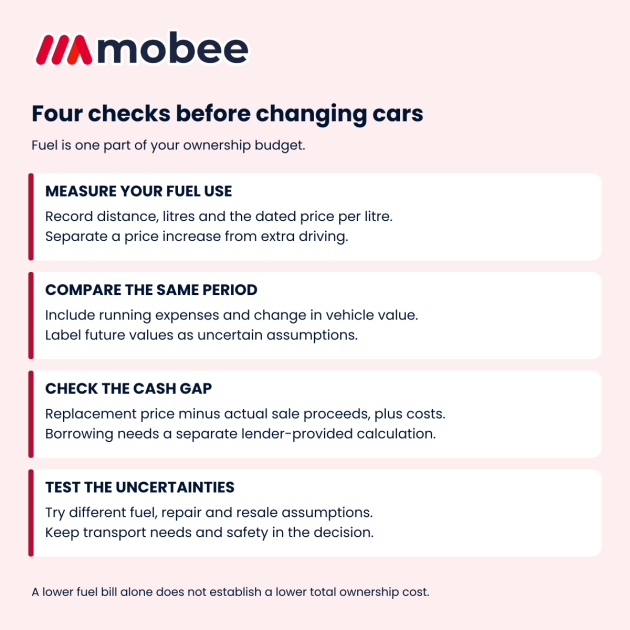
Measure your fuel use, compare the same period, check the cash gap and test uncertain costs before deciding.
If either car has a loan, get the lender’s figures
The worked example does not cover an outstanding loan. Ask your lender for the applicable settlement computation and requirements before planning a sale. An estimated car value does not establish your net proceeds or permission to complete a transfer.
For new borrowing, ask for the effective interest rate, all fees, payment schedule and total repayment. BSP’s loan-calculator guidance explains why the effective interest rate matters. Compare cash affordability as well as total cost; a smaller monthly instalment can come with a longer repayment period.
Do not treat this guide as a loan-settlement or ownership-transfer procedure. Resolve the requirements with the relevant lender and authorities before committing.
When keeping, replacing or selling may fit
- Keeping may fit if the car remains suitable, its condition is acceptable, and realistic costs are manageable without a costly changeover.
- Replacing may fit if a properly assessed alternative meets your needs and the full comparison, cash requirements and risks work for you.
- Selling without replacing may fit if reliable alternatives cover your journeys at a suitable cost; include transport fares, occasional rentals and practical limitations.
Consider passenger and cargo needs, accessibility, journey reliability and your time—not only fuel economy. If the car has a safety concern, have it assessed promptly; a budget comparison is not permission to keep driving an unsafe vehicle.
When comparing trade-in and separate-sale options, obtain written terms for both the old car and the replacement. Our trade-in comparison covers the purchase gap and timing. For resale assumptions, use relevant offers and vehicle details rather than a fixed brand-wide depreciation rate.
Reduce avoidable fuel use while you assess the options
Plan or combine suitable errands, remove unnecessary cargo and drive smoothly within posted limits and conditions. US DOE/EPA efficiency guidance supports avoiding aggressive acceleration and unnecessary idling; its numerical US savings estimates are not used here.
Follow your vehicle’s maintenance schedule. Check tyre pressure when cold using the vehicle manufacturer’s placard or manual, not a generic pressure for all cars. NHTSA’s tyre guidance explains this distinction. Do not overinflate tyres to chase savings, and have unusual consumption or a warning assessed appropriately.
Use safety systems and air conditioning as needed for visibility and safe travel. Do not switch off an engine while moving or compromise safety for a claimed fuel saving. Changes in habits are useful to assess, but no fixed saving is guaranteed.
Start with a clearer view of your car’s offer
Mobee Cars Philippines offers a free inspection, no seller fees and access to 300+ verified used-car dealers. Offers arrive within hours after inspection. Use the actual offer and confirmed conditions in your comparison; an initial estimate is not a guaranteed final price.
Submit your vehicle details or contact Mobee Cars Philippines at +63 960 399 9990 to discuss the next step. Offer timing is separate from completed payment and handover. You can review your options without assuming that selling or replacing is automatically the right answer.
Sources checked on 27 October 2026. This is a general decision framework, not a personalised financial recommendation, current fuel-price bulletin or prediction of resale values.
Have a question about your car?
Ask our team