
Blog > Seller Guide > Finance
The Total Cost of Owning a Car in the Philippines: Build a Realistic Budget

Illustrative owner preparing a car budget; no real customer, quotation or financial result is shown.
A car’s purchase price is only one part of its cost. A useful ownership budget also includes financing where applicable, insurance, registration-related expenses, maintenance, fuel or charging, parking, tolls and the amount you may eventually recover when you sell.
Start with your own distance, parking arrangements and written quotations. Separate the cash you need from the cost of using the vehicle over time. The worked example below uses invented figures to explain the method—not current Philippine market prices or a recommended budget.
1. Choose the period and the question you want to answer
For an affordability check, list the cash payments due during your first year and the months when they fall. For a longer-term comparison, choose the same ownership period and driving distance for each vehicle, then estimate purchase and running costs minus eventual sale proceeds.
Do not add the full purchase price and depreciation together in the same ownership-cost total. Depreciation is the reduction between what you paid for the vehicle and its later resale value. Counting both would count part of the vehicle’s value twice.
2. Record the purchase price and financing separately
Get an itemised written quotation. Identify what the price includes and what you must pay separately, such as insurance, registration-related charges or accessories. A bundled item should appear only once in your budget.
If borrowing, record the down payment, instalments, fees, payment dates and any final balloon payment. Ask the lender for the effective interest rate, total repayment and full charges. BSP’s loan-calculator guidance explains why the effective interest rate helps compare borrowing costs; the lender must provide the actual calculation for its offer.
For cash-flow planning, use the payments actually due in the period. For total ownership cost, use the vehicle purchase price once, then add financing interest and fees—not the loan principal again. A low monthly instalment alone does not show the full amount you will pay.
3. Obtain insurance and registration figures for your vehicle
The Insurance Commission explains that compulsory motor vehicle liability insurance is a registration requirement and covers specified third-party or passenger death or bodily injury. It is not a substitute for checking protection for damage to your own car.
Request insurance quotations using consistent vehicle details, use, insured value and policy dates. Check the premium, deductible or participation fee, exclusions and whether theft, flood or other Acts of Nature protection is included. Oona’s insurance-comparison guide explains why similar-looking premiums can cover different risks. Read the actual policy before relying on a benefit.
Confirm the applicable registration, inspection or testing requirements and charges with LTO and the relevant authorised provider. Use the vehicle’s actual due date rather than assuming every new car has the same first-year renewal payment. Keep insurance charges separate where they are not already included in a bundle.
4. Budget for scheduled service and unexpected work
Use your exact model’s maintenance schedule and request a quotation for the services due during your chosen period. Toyota Philippines’ PMS page, for example, lists different intervals for different vehicle groups. A schedule for one model or powertrain should not be applied to every car.
Include consumables or wear items likely to need attention, based on the vehicle’s condition and professional assessment. For a used car, obtain a competent inspection and price known work before treating it as affordable. This guide does not set a universal tyre-replacement age or annual repair bill.
A repair reserve is money set aside for uncertainty. Keep it visible in your cash plan, but do not describe an untouched reserve as money already spent. If a repair occurs, record the expense once and adjust the reserve separately.
5. Calculate energy costs from distance and consumption
For petrol or diesel, use: monthly kilometres ÷ kilometres per litre × price per litre. Your own recent fill-up records are more useful than treating a single advertised figure as guaranteed consumption.
Hypothetical example: 1,000 km per month ÷ 12 km/L × ₱60/L = ₱5,000 per month, or ₱60,000 for twelve identical months. The distance, economy and price are assumptions, not measured averages or today’s pump price.
If the same example uses ₱70/L, the result becomes about ₱5,833 per month. If consumption instead falls to 10 km/L at ₱60/L, it becomes ₱6,000. Change one input at a time to see what matters to your budget.
Check your local station’s current price and the Department of Energy’s fuel-price information, then date the figure you use. Traffic, route and driving conditions can change your own consumption; update the calculation using your records.
For an EV, begin with the electricity billed for charging multiplied by the applicable rate, then add session, parking or other charging fees. If estimating from a vehicle’s consumption figure, check whether it includes charging losses. Include home-charger or installation costs where relevant. An EV does not have zero energy costs, and one monthly charging figure will not fit every driver.
6. Include parking, tolls and optional services
Count home and workplace parking, occasional paid parking and the tolls for your actual routes. Include roadside assistance if you intend to pay for it, checking whether similar cover is already part of your insurance or another package.
Record annual bills separately from monthly ones so you can prepare for the due dates. An annual average can help comparison, but it does not mean every bill will arrive in equal monthly amounts.
A worked first-year cash budget
This example assumes a cash purchase, twelve months of use, no loan and no included bundles. Every amount is hypothetical. The registration-related allowance excludes insurance, which has its own row; actual applicable charges must be confirmed.
Hypothetical first-year item: Vehicle cash purchase
Cash outlay: ₱800,000
Hypothetical first-year item: Insurance allowance
Cash outlay: ₱24,000
Hypothetical first-year item: Registration-related allowance (excluding insurance)
Cash outlay: ₱5,000
Hypothetical first-year item: Scheduled maintenance allowance
Cash outlay: ₱12,000
Hypothetical first-year item: Fuel (1,000 km/month ÷ 12 km/L × ₱60/L × 12)
Cash outlay: ₱60,000
Hypothetical first-year item: Parking allowance
Cash outlay: ₱36,000
Hypothetical first-year item: Toll allowance
Cash outlay: ₱12,000
Hypothetical first-year item: Total planned first-year cash outlay
Cash outlay: ₱949,000
The running-cost rows total ₱149,000, or about ₱12,417 per month when averaged over a year. Adding the ₱800,000 purchase gives ₱949,000 in planned first-year cash outlay. This is a teaching example, not a quote for a named vehicle.
If you also choose to set aside a hypothetical ₱12,000 repair reserve, the cash you plan to have available becomes ₱961,000. The unused reserve remains your money; it is not included in the ₱949,000 spending total.
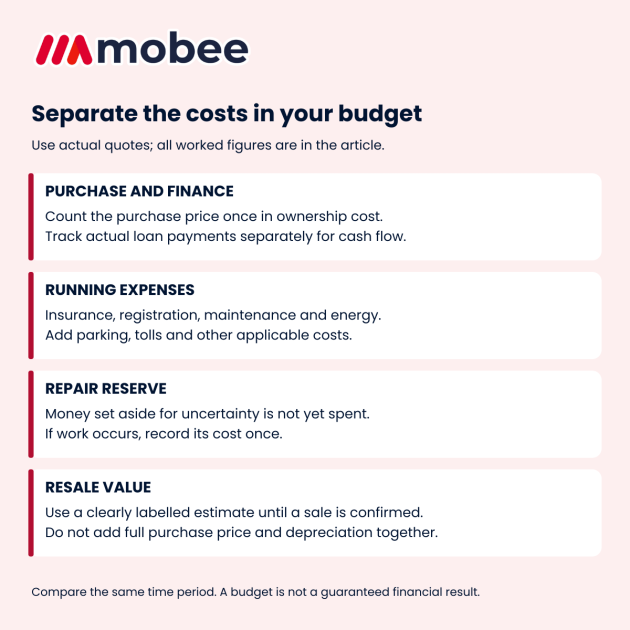
Separate purchase and running payments, an unspent repair reserve, and the change in the vehicle’s resale value.
How resale value changes the longer-term calculation
Suppose the example car is sold after one year for a hypothetical ₱720,000. Its loss in vehicle value is ₱800,000 − ₱720,000 = ₱80,000. Add the ₱149,000 running expenses to obtain a simplified one-year ownership cost of ₱229,000.
This second calculation excludes financing, selling expenses, opportunity cost and any repairs not shown. Add applicable costs once. If the resale proceeds differ, the result changes; the ₱720,000 figure is not a forecast or a standard depreciation rate.
For a sale you are actually planning, compare realistic offers and their conditions. Asking prices in advertisements are not proof of completed sale prices. Do not rely on a fixed annual depreciation percentage for every brand, model and condition.
Before you decide, check these five inputs
- The itemised purchase quote and, if borrowing, the lender’s complete payment schedule.
- Insurance cover and applicable registration-related charges for this vehicle.
- A realistic maintenance plan, known repair quotations and a separate reserve.
- Your distance, energy use, parking and tolls, with dates for variable prices.
- The same comparison period, a clearly labelled resale assumption and no double counting.
Considering selling your current car?
Mobee Cars Philippines offers a free inspection, no seller fees and access to 300+ verified used-car dealers. Offers arrive within hours after inspection. Use the actual offer and confirmed conditions when updating your budget; an estimate is not a guaranteed sale price or a completed payment.
Submit your vehicle details or use the official contact page to discuss the next step. You can also call +63 960 399 9990. Selling and replacing a car are separate budget decisions: compare the full costs before committing.
Sources checked on 27 October 2026. This is a general budgeting framework, not a personalised loan, insurance or investment recommendation.
Was this article helpful?
How to Spot a Fake OR/CR in the Philippines
17 April 2025 Mobee Cars PhilippinesVoluntarily Surrendering a Car to the Bank in the Philippines: What to Check First
17 May 2025 Mobee Cars PhilippinesHow to Check Flood-Prone Areas in the Philippines: Official Resources for Car Owners
15 November 2024 Mobee Cars PhilippinesNo comment yet. Be the first to comment.