Diesel vs Gasoline in the Philippines: Compare Fuel Use and Ownership Costs

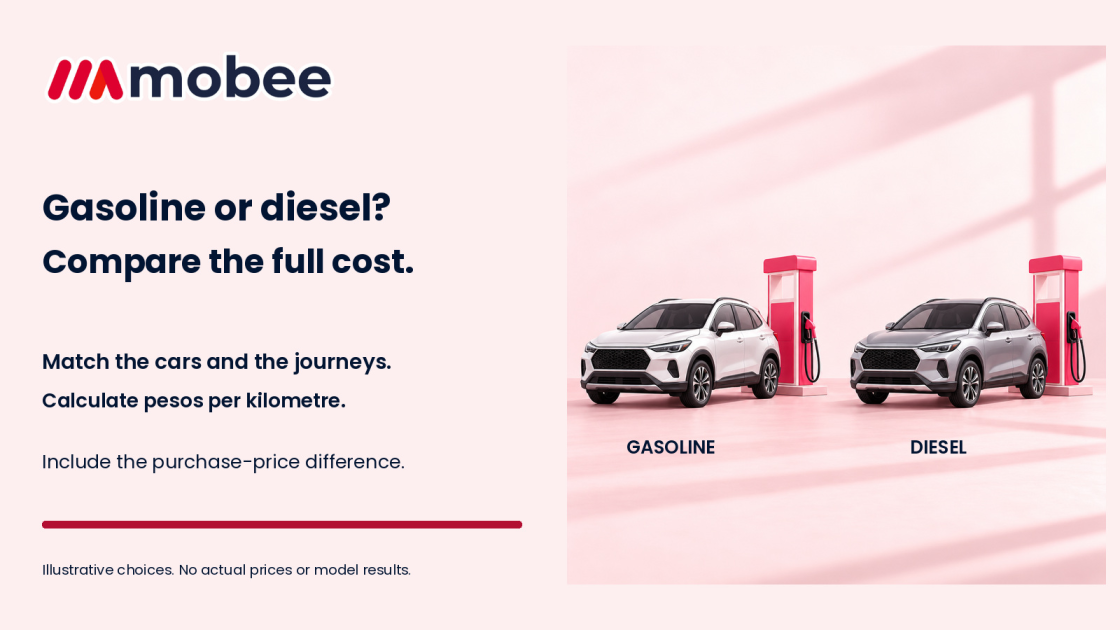
Illustrative gasoline and diesel choices, not named models, actual fuel prices or a claim that either option wins.
Diesel can offer better fuel economy than a comparable gasoline vehicle, but the fuel type alone does not tell you which car will cost less to own. Compare the exact vehicles, your journeys, local fuel prices and the difference in purchase and maintenance costs.
In this guide, “gas” means gasoline or petrol—not LPG. The worked example uses invented figures to show the calculation. It is not a Philippine fuel-economy test, a current price quotation or a recommendation for a particular model.
What is the difference between gasoline and diesel engines?
Most gasoline engines ignite the air-fuel mixture using a spark. Diesel engines inject fuel into air heated by compression, causing ignition. Both are internal-combustion engines, but their fuel systems and requirements differ. The US Department of Energy’s engine explainer describes this basic distinction.
Many diesel vehicles also have exhaust-treatment equipment, which can include a diesel particulate filter (DPF) and other systems. Equipment varies by model, year and market; do not assume every Philippine diesel has the same components or fluid requirements.
Use the fuel type and specification required by the vehicle manufacturer. Read the filler label and the correct owner’s manual; fuel price is not a reason to substitute gasoline for diesel or vice versa. Pump colours alone are not a reliable way to identify the fuel your car needs.
Is diesel always more fuel-efficient?
US DOE/EPA guidance explains that diesel engines can be more efficient than similar-sized gasoline engines, and that fuel energy content also matters. That is a useful engineering starting point, not proof that every diesel SUV will beat every gasoline hatchback on a Philippine route.
For a fair comparison, identify the model year, engine, transmission, vehicle size and condition. Compare figures measured under the same test method and similar conditions. Do not set a highway result beside a city result and treat the difference as an engine-only advantage.
Actual consumption also depends on driving conditions, maintenance and the vehicle itself. The DOE/EPA explanation of mileage variation makes clear that a standardised test estimate is not a promise of what an individual driver will achieve.
If possible, use records from the car you own and credible evidence for the exact alternative. Record distance and litres over multiple refills under comparable use. Kilometres per litre (km/L) means farther is better; litres per 100 km (L/100 km) means lower is better. Convert consistently: L/100 km = 100 ÷ km/L.
Calculate pesos per kilometre, not just litres used
Estimated fuel cost per kilometre = price per litre ÷ kilometres per litre. Monthly fuel cost = that result × monthly distance. Use the correct fuel grade, location and date. DOE’s fuel-price directory is an official reference point; your own dated station price is the practical input for your route.
Suppose two suitable candidate cars cover 1,000 km a month, or 12,000 km a year. Assume the gasoline car achieves 12 km/L at ₱60/L, while the diesel achieves 15 km/L at ₱55/L. These are hypothetical inputs, not measured results or current pump prices.
Hypothetical comparison: Assumed consumption
Gasoline car: 12 km/L
Diesel car: 15 km/L
Hypothetical comparison: Assumed fuel price
Gasoline car: ₱60/L
Diesel car: ₱55/L
Hypothetical comparison: Fuel cost per kilometre
Gasoline car: ₱5.00
Diesel car: ₱3.67 (rounded)
Hypothetical comparison: Fuel cost at 1,000 km/month
Gasoline car: ₱5,000
Diesel car: ₱3,666.67 (rounded)
Hypothetical comparison: Fuel used at 12,000 km/year
Gasoline car: 1,000 litres
Diesel car: 800 litres
Hypothetical comparison: Fuel cost at 12,000 km/year
Gasoline car: ₱60,000
Diesel car: ₱44,000
The assumed diesel uses 200 fewer litres and costs ₱16,000 less in fuel over a year. That conclusion applies only to these inputs. Different vehicles, fuel prices or driving conditions can change the result. Rounded monthly amounts are shown; annual figures use unrounded calculations.
Will fuel savings recover a higher purchase price?
If the diesel candidate costs a hypothetical ₱120,000 more to buy, dividing that extra price by the example’s ₱16,000 annual fuel saving gives 7.5 years. This is only a fuel-only payback calculation: it ignores financing, maintenance differences, insurance, resale value and the time value of money.
At 6,000 km a year with the same consumption and prices, the fuel saving is ₱8,000 and the fuel-only payback becomes 15 years. At 24,000 km, the saving is ₱32,000 and payback is 3.75 years. Annual distance matters, but the car still needs to suit your journeys.
Test the price assumption too. If the hypothetical diesel price rises to ₱65/L while the gasoline price stays ₱60/L, diesel fuel costs ₱52,000 a year at 12,000 km. The saving falls to ₱8,000 and the same purchase-price premium takes 15 years to recover on fuel alone. This is a scenario, not a price forecast.
Do not call this the total cost of ownership. Compare scheduled service quotations, likely repairs, insurance, financing and uncertain future resale values over the same period. Our ownership-cost guide separates running expenses, purchase cash and depreciation so they are not counted twice.
City use, short trips and maintenance: check the exact car
There is no reliable blanket rule that gasoline is always cheaper for city use or diesel always wins on provincial journeys. Match the vehicle to your annual distance, trip length, passengers, load and service access. Compare condition and records as carefully as the fuel type.
For a diesel with a DPF, ask how your trip pattern fits its manufacturer’s guidance. As one model-specific example, the January 2014 Philippine Ford Focus manual discusses short, stop-start journeys in its DPF section. That older manual is not an instruction sheet for every diesel sold today.
Follow the manual for the exact vehicle and have warning lights or suspected faults assessed appropriately. Do not use a generic internet “regeneration drive,” remove emissions equipment or assume a long trip will fix a fault. This guide provides no DIY regeneration procedure.
Request itemised maintenance quotations for the correct variant and service interval, plus an inspection for a used car. A fuel label cannot establish engine durability, repair cost or remaining life. A cheaper purchase with overdue work may need a different budget from a well-maintained alternative.
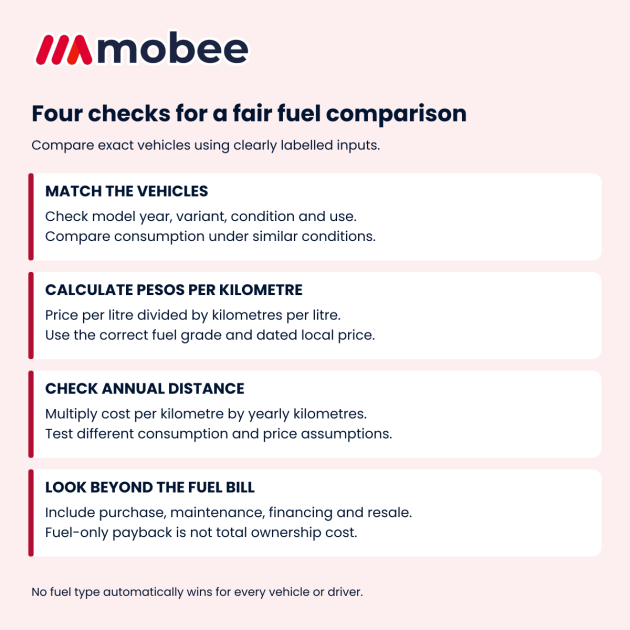
Compare matched vehicles, calculate fuel cost, check annual distance and include costs beyond fuel.
What about hybrids or electric cars?
Treat a hybrid or electric candidate as another specific vehicle to assess, not an automatic winner. Include its purchase price, applicable energy costs, charging arrangements where relevant, maintenance, warranty and resale assumptions. Electricity is not automatically free, and tax or road-use benefits need their own current, applicable evidence.
If you are replacing a car you already own, compare the full keep-versus-replace decision. Lower energy spending does not by itself justify the cash needed to change cars.
Compare the offer for your current car
Mobee Cars Philippines provides free inspection, no seller fees and access to 300+ verified used-car dealers. Offers arrive within hours after inspection. Use the actual offer and confirmed terms when estimating the cash needed for a replacement; an initial estimate is not a guaranteed final sale price.
Submit your car details or contact Mobee Cars Philippines at +63 960 399 9990 to discuss the next step. Offer timing is separate from completed payment and handover. Decide using the specific cars and your full budget, rather than a promise that one fuel type always saves money.
Sources checked on 27 October 2026. Examples are hypothetical; no current fuel price, model-specific economy result, future resale value or guaranteed saving is asserted.
Was this article helpful?
How to Spot a Fake ORCR in the Philippines
17 April 2025 Mobee Cars PhilippinesVoluntarily Surrendering a Car to the Bank in the Philippines: What to Check First
17 May 2025 Mobee Cars PhilippinesHow to Check Flood-Prone Areas in the Philippines: Official Resources for Car Owners
15 November 2024 Mobee Cars PhilippinesNo comment yet. Be the first to comment.