Flood Safety for Car Owners in the Philippines: Before, During and After

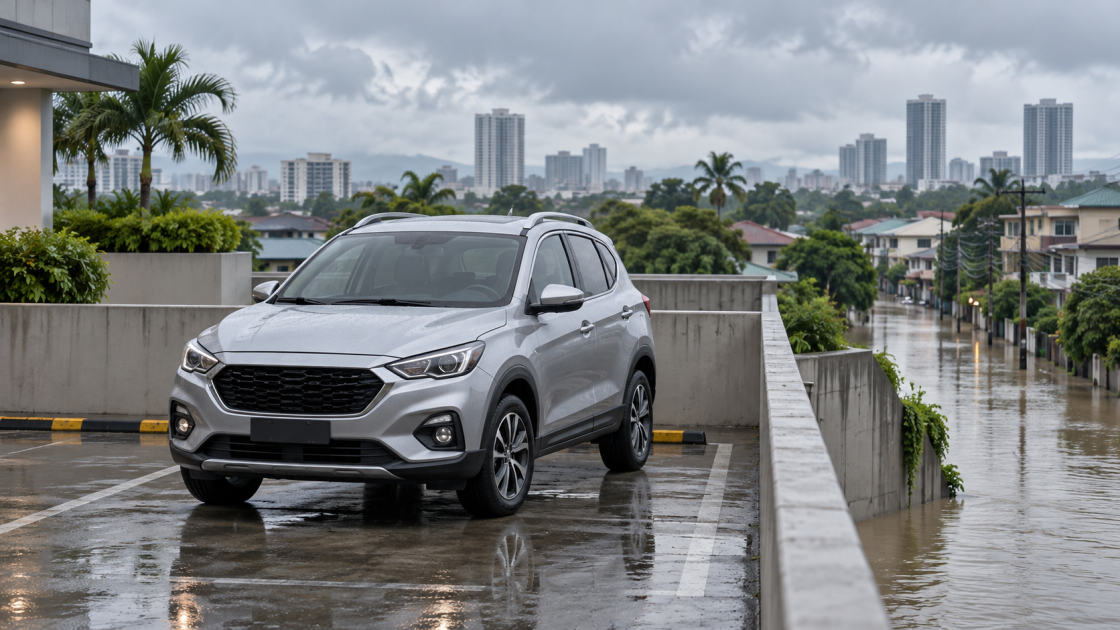
AI-generated illustration: park away from floodwater before conditions become dangerous.
When flooding threatens, follow PAGASA and local government warnings, avoid flooded roads and evacuate early when instructed. If your car has been submerged or you suspect water has entered it, keep it switched off and arrange professional assessment before using it. People’s safety comes before protecting the vehicle.
This guide covers preparation, avoiding floodwater and the first steps after a vehicle is affected. Local evacuation instructions and your vehicle manufacturer’s guidance take priority.
Before flooding: prepare while access is safe
Start with PAGASA’s flood information and your city or municipal disaster-risk office. Check the bulletin’s issue time and the places it covers. A familiar route or last year’s forecast is not a substitute for the latest warning.
PAGASA’s flood-safety guidance recommends knowing your community warning system, agreeing on an evacuation area and leaving before floodwater cuts off access. Decide where your household will go and how you will get there.
Plan higher-ground parking in advance, but move the car only while the route and destination remain safe and local authorities permit access. Do not delay an evacuation or return through floodwater to retrieve it. Keep evacuation essentials accessible; Quezon City’s disaster office recommends a Go Bag and an evacuation plan.
Save your insurer’s and vehicle service provider’s contact details somewhere you can reach without entering the car. For broader planning resources, see our guide to flood-prone areas in the Philippines. Use official local alerts for current road and evacuation decisions.
During flooding: do not test the water with your car
Do not drive or walk through flooded areas. Quezon City’s official guidance gives this instruction directly. If your planned route is flooded, do not enter it; follow local instructions for a safe alternative or a safe place to wait.
Do not use the midpoint of your wheels—or another vehicle crossing—as permission to proceed. This guide gives no water-depth threshold that makes a flooded road safe. A vehicle’s advertised capability is not clearance to ignore a closure or evacuation order.
If you are in immediate danger, contact local emergency responders and follow their instructions. Do not re-enter floodwater to save the car or collect belongings.
After flooding: leave the car off and get help
A car that looks dry may still need assessment. The US National Highway Traffic Safety Administration warns that flood damage can be hidden and recommends a thorough check before starting the vehicle. This is vehicle-safety guidance, not a Philippine legal requirement.
If the vehicle was submerged or you suspect water entered it, do not start it to see whether it still works. Contact your manufacturer’s authorised service centre or a qualified repair provider and explain what happened. Ask how the vehicle should be recovered and inspected.
Mitsubishi Motors Philippines advises professional inspection after submersion, including the engine, transmission, electrical system, brakes and interior. It also recommends recording the waterline and damage. Take photographs only after the water has receded and you can safely approach. Let the professionals handle recovery and electrical work.
Electric and hybrid vehicles need particular care
If you suspect flood damage to an EV or hybrid battery, do not drive or charge the vehicle. Stay away from a damaged vehicle and contact its dealer for specialist assistance. Florida’s environmental agency gives this advice in its flood-damaged battery guidance; NHTSA also warns of shock and fire hazards. These physical-safety precautions do not replace the instructions for your particular model.
Insurance: check your own flood cover
Do not assume the word “comprehensive” confirms flood cover. For example, AXA Philippines lists Acts of Nature cover, including flood, as an optional/add-on benefit in its motor product. That is one provider’s product description, not a promise about your policy.
Read your policy schedule and endorsements, then ask your insurer:
- Is this event covered under my policy?
- What notification deadline, documents and photographs are required?
- Must you authorise towing, inspection or repairs first?
- What excess, exclusions or limits apply?
Keep the insurer’s instructions and your repair records. Do not assume that a photograph, inspection or repair automatically guarantees a paid claim.
Quick checklist
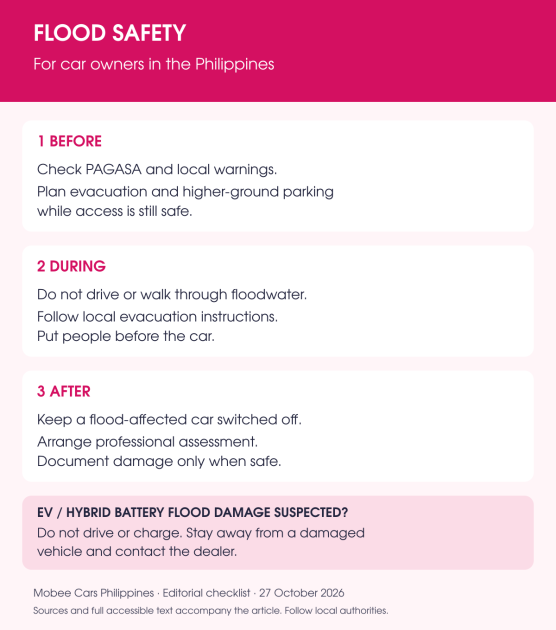
A preparation and recovery reminder—not a live road-status notice.
Before: check PAGASA and local warnings; plan evacuation and higher-ground parking while access is safe.
During: avoid flooded roads; follow evacuation instructions; put people before the car.
After: keep a flood-affected car off; arrange professional assessment; document damage only when safe.
EV or hybrid battery damage suspected: do not drive or charge; contact the dealer.
Common questions
Can I start the car once the floodwater has gone?
Not simply because it looks dry. If it was submerged or you suspect water entry, arrange assessment before starting or using it.
Does this guide tell me whether a road is open now?
No. Check the latest PAGASA information and local government advisories for your location. This article is an evergreen preparation guide, not a live road-status service.
Thinking about selling later?
Once the immediate safety issue is addressed, you can read Mobee Cars Philippines’ car-selling guide or contact Mobee Cars at +63 960 399 9990 about selling. PH vehicle inspections are free and there are no seller fees. Ask about eligibility before making arrangements; this article does not confirm acceptance of a flood-affected vehicle. A selling appraisal is not a substitute for post-flood safety assessment.
Sources checked: 27 October 2026. Sources are linked beside the relevant guidance. This article does not provide medical treatment, vehicle repair instructions or an individual insurance-coverage decision.
Was this article helpful?
How to Spot a Fake ORCR in the Philippines
17 April 2025 Mobee Cars PhilippinesVoluntarily Surrendering a Car to the Bank in the Philippines: What to Check First
17 May 2025 Mobee Cars PhilippinesHow to Check Flood-Prone Areas in the Philippines: Official Resources for Car Owners
15 November 2024 Mobee Cars PhilippinesNo comment yet. Be the first to comment.