Buying a Used Car in the Philippines: A First-Time Buyer’s Checklist

Illustrative buyer reviewing a parked car; the image does not establish the vehicle’s condition or certify an inspection.
Before buying a used car, check five things together: whether it suits your needs, whether you can afford the full cost, who is selling it, what the vehicle’s records and condition show, and how payment and ownership transfer will be handled.
A low asking price or low odometer reading cannot answer all those questions. Use this checklist to organise your checks and identify reasons to pause. It is general buying guidance, not a complete LTO transfer checklist or a guarantee that a particular car is safe or legally transferable.
1. Set a budget that leaves room for ownership
Start with your regular journeys, passengers, parking and cargo needs. Shortlist specific model years and variants that fit those needs, then compare their condition and asking prices. A used vehicle may cost less to buy than a comparable new one, but repairs and other expenses can change the overall comparison.
Separate the purchase budget from ongoing fuel or energy, insurance, registration-related costs, maintenance, tyres, parking and tolls. Keep room for an inspection, known work identified before purchase and unexpected expenses. Use quotations for your actual situation rather than a fixed percentage of salary that supposedly suits everyone.
Our ownership-cost guide explains the difference between purchase cash, running costs and depreciation. A lower monthly payment does not by itself make a car affordable.
If you plan to borrow, ask the lender for the effective interest rate, all fees, down payment, instalment schedule and total repayment. BSP’s loan-calculator guidance explains why the effective interest rate matters and why the actual calculation should come from your lender. Compare quotations over the same period and check your other obligations.
2. Identify the seller and the exact vehicle
Listings can come from individual owners, dealers or businesses advertising through online platforms. Establish who owns the vehicle, who is authorised to sell it, who receives payment and which business or person is responsible for the written terms. An online listing is a starting point for enquiries, not verification by itself.
Ask for the model year, variant, transmission, recorded mileage, service history and an explanation of known damage or repairs. Confirm that the car you inspect is the same vehicle described in the documents and proposed agreement. Do not rely on a generic stock photo or a similar car in another advertisement.
If the seller is not the registered owner, or the car has an outstanding loan, do not assume an informal explanation or promise to “fix the papers later” resolves the issue. Ask the relevant authorities, lender and a qualified adviser what evidence is needed for that specific case before committing.
3. Check records and the transfer route before paying
Ask to review the vehicle’s registration documents, including its Official Receipt and Certificate of Registration, alongside seller-identification and sale documents. Check the vehicle identifiers and names for inconsistencies. A matching-looking document is a screening clue, not proof of authenticity or authority to sell.
Our OR/CR verification guide explains why appearance alone is insufficient. LTO has also issued guidance on temporary CRs, so do not reject or accept a document solely because its paper looks different. Confirm the applicable record and document format with LTO through official channels.
Before committing, ask LTO and PNP-HPG about the current requirements for the proposed transaction. Agree who will obtain the required documents, handle verification, pay the applicable charges and follow up the transfer. Ask the insurer separately about cover for your situation; do not assume the previous owner’s arrangement automatically covers you.
This is not an exhaustive document list. Different ownership, financing or representation circumstances may require different evidence. Do not rely on a fixed transfer deadline, fee or completion time quoted in an old blog. If identity, authority or required records remain unclear, pause the purchase until they are resolved.
4. Read mileage together with the car’s history
There is no universal mileage figure that makes every used car a good or bad buy. Compare the odometer with dated service and inspection records, the car’s age, previous use and observed condition. Ask about gaps, unusual changes or a replaced instrument cluster rather than assuming the displayed number tells the whole story.
NHTSA’s odometer guidance recommends comparing readings with maintenance records and visible wear. Those are useful screening principles, but wear alone cannot prove tampering. Its US fraud statistics and legal rules are not Philippine benchmarks.
A car with more kilometres and well-documented care may deserve consideration alongside a lower-mileage car with unclear history. Have a competent inspector assess the specific vehicle; do not use 60,000 km or 100,000 km as automatic approval or rejection thresholds.
5. Arrange an independent inspection
Ask permission for an inspection by a competent mechanic or inspection service you choose. Request a written report identifying the vehicle, what was checked, any limitations and estimated work needed. A service history or seller’s inspection report is useful, but it does not replace your own assessment of the purchase.
The US Federal Trade Commission recommends an independent mechanical inspection even for a dealer-inspected or certified used car. This is a practical inspection principle, not an application of US consumer law to a Philippine sale.
Ask the inspector about mechanical and electrical condition, safety concerns, signs of previous repair, and evidence that needs further investigation. A test drive, where safe and properly authorised, can help assess suitability; it is not a substitute for inspection. Do not drive a vehicle with an unresolved safety concern simply to complete the checklist.
If flood exposure is suspected, pause and seek an appropriate professional assessment before testing or using the vehicle. No fresh upholstery, clean engine bay or checklist can establish that a car is flood-free. Refusal to allow reasonable checks is a reason to reconsider the purchase.
6. Read the actual warranty and sale terms
Do not assume every used car from a dealer carries the same warranty. Toyota Philippines’ T-Sure programme, for example, distinguishes categories with different warranty arrangements, including a category with no warranty coverage. That is a programme-specific example, not a statement about every dealer or a recommendation for a particular vehicle.
Ask for the exact written coverage, exclusions, duration, claim process and responsible provider for the car you are considering. Clarify any repair promise, optional product or deposit condition before paying. If contract language or an “as-is” term is unclear, seek qualified advice rather than guessing what rights it changes.
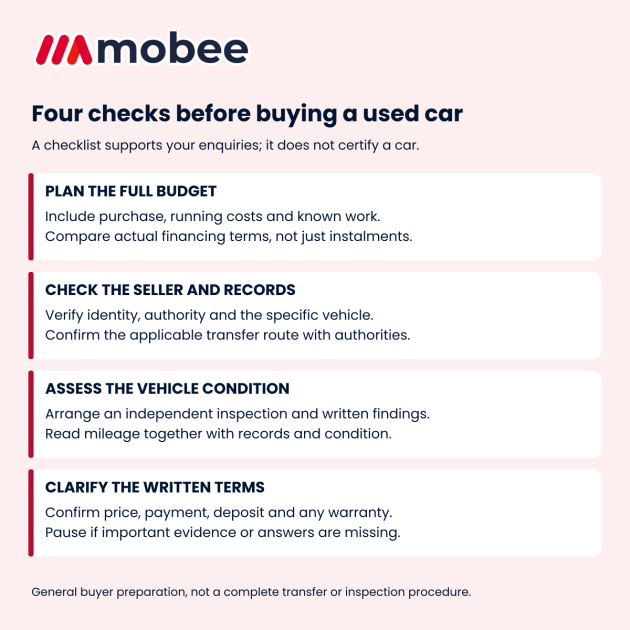
Check the budget, seller and records, physical condition, and written transaction terms before committing.
A final check before you commit
Check: Budget
Question to answer before committing: Can I cover the purchase and realistic ownership costs?
Check: Seller and vehicle identity
Question to answer before committing: Have the seller’s authority, records and vehicle details been checked?
Check: Condition
Question to answer before committing: Do I understand the inspection findings, limitations and likely work?
Check: Written terms
Question to answer before committing: Are price, payment recipient, deposit conditions and any warranty clear?
Check: Transfer and handover
Question to answer before committing: Are responsibilities, required evidence and next steps confirmed for this case?
Keep copies of the agreed terms, receipts and records you are entitled to receive, and protect personal information. Do not let urgency, a limited-time discount or pressure to pay replace verification. If an important answer is still missing, it is reasonable to pause and compare another vehicle.
When you later need to sell your car
Mobee Cars Philippines helps car owners sell through its network of 300+ verified used-car dealers. It offers free inspection, no seller fees and offers within hours after inspection. This seller service should not be confused with a consumer inventory-browsing or used-car purchase service.
When you have a car to sell, submit its details or contact Mobee Cars Philippines at +63 960 399 9990. Confirm the actual offer and transaction terms; an estimate is not a guaranteed final price, and offer timing is separate from completed payment and handover.
Sources checked on 27 October 2026. This guide does not certify a vehicle, replace professional inspection or determine the legal requirements of an individual sale.
Was this article helpful?
How to Spot a Fake ORCR in the Philippines
17 April 2025 Mobee Cars PhilippinesVoluntarily Surrendering a Car to the Bank in the Philippines: What to Check First
17 May 2025 Mobee Cars PhilippinesHow to Check Flood-Prone Areas in the Philippines: Official Resources for Car Owners
15 November 2024 Mobee Cars PhilippinesNo comment yet. Be the first to comment.