Getting started
How to Sell a TNVS or Former Ride-Hailing Car in the Philippines
Illustrative Vehicle Appraiser checking a parked vehicle; not an actual employee or listing.
Selling a car used for ride-hailing involves two questions: who owns the vehicle, and what must happen to its transport-service records? Answer both before arranging the sale. Removing a car from an app does not, by itself, show that its LTFRB or LTO records have been updated.
For Mobee, the applicable TNVS, franchise and unit-status issues must be resolved before the vehicle appraisal is scheduled. Tell the team about the car’s ride-hailing use and provide the records you have so the necessary preparation can be identified.
This guide covers cars used for Transport Network Vehicle Service (TNVS), including former ride-hailing cars. It is not a motorcycle-taxi guide. The steps and documents depend on the vehicle’s records, the receiving office, lender and platform.
1. Establish the ownership and TNVS status
TNVS describes a transport-service use; it is not a separate ownership type. A ride-hailing car can be privately owned, company-owned or financed. Check whose name appears on the Certificate of Registration, who has authority to sell and whether a lender still holds documents or has outstanding requirements.
Gather the available OR/CR, relevant Certificate of Public Convenience (CPC) or Provisional Authority (PA), case or unit details, platform records and any previous applications or orders. Confirm what is active, expired, pending or already completed. If the records disagree, resolve the discrepancy rather than assuming the app shows the complete position.
Match the registration details to the actual vehicle. Our OR/CR checking guide explains why visible documents alone do not prove that every record is valid or up to date.
2. Confirm the correct LTFRB procedure
Ask the LTFRB office handling your case which action applies to the vehicle. The official LTFRB-NCR service portal lists franchise verification, dropping a unit, and dropping and substitution as distinct services. It is an NCR reference; confirm the correct office and procedure for your case.
Dropping and substitution concerns replacing a unit under the relevant authority. It should not be treated as the default procedure for every owner selling a car. Grab’s 2026 TNVS FAQ describes replacement under the same franchise and lists its conditions; that platform guidance is not a universal checklist for all sales.
Before filing, ask which application is appropriate, who must apply, what documents are required and what order or confirmation will show completion. Keep the issued records. Do not assume that selling the physical car also transfers a franchise, platform account or authority to operate.
3. Coordinate the separate records
Several organisations may need information about the planned sale or change of use. One update does not automatically complete the others:
- LTFRB: confirm the franchise and unit status, applicable process and evidence of completion.
- LTO: confirm registration, ownership and any classification update needed for the intended use, with the documents the office requires.
- Ride-hailing platform: ask how to remove or update the vehicle in its system, and keep its confirmation. This is separate from government records.
- Lender and insurer: confirm any outstanding settlement, release, coverage or change-of-use requirements directly with the relevant organisation.
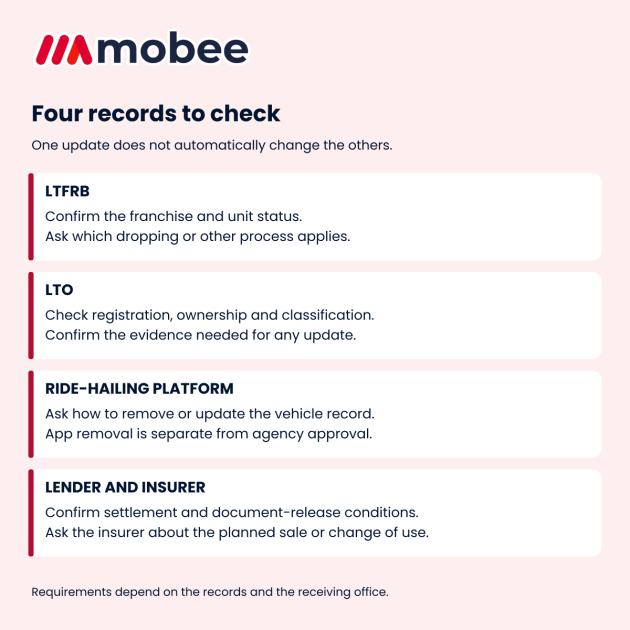
Keep the agency, platform, lender and insurance records separate and confirm what each requires for your case.
If the car is financed, ask the lender for the settlement arrangements and document-release conditions before accepting a sale schedule. If its insurance will need to change, ask the insurer about the effective date and any remaining obligations. Do not assume that uninstalling an app or signing a sale deed cancels every obligation.
4. Prepare a clear vehicle-history file
Disclose the car’s ride-hailing use, mileage, known faults, accident repairs and any flood exposure. Service history and repair records help explain how it has been maintained. A former ride-hailing label alone does not establish its mechanical condition or value.
Gather the spare keys, service records and accessories included in the sale. Make the vehicle accessible for inspection. If a defect affects safe driving, obtain appropriate professional advice or arrange suitable transport instead of driving it merely to attend an appointment.
Prepare an organised file for the team to review:
- Available OR/CR and identification, with ownership or authority concerns disclosed.
- Relevant TNVS/franchise/unit records, applications, orders and confirmations.
- Any lender settlement or document-release correspondence.
- Relevant insurance information and confirmation of any required changes.
- Mileage, service and repair history, keys and included accessories.
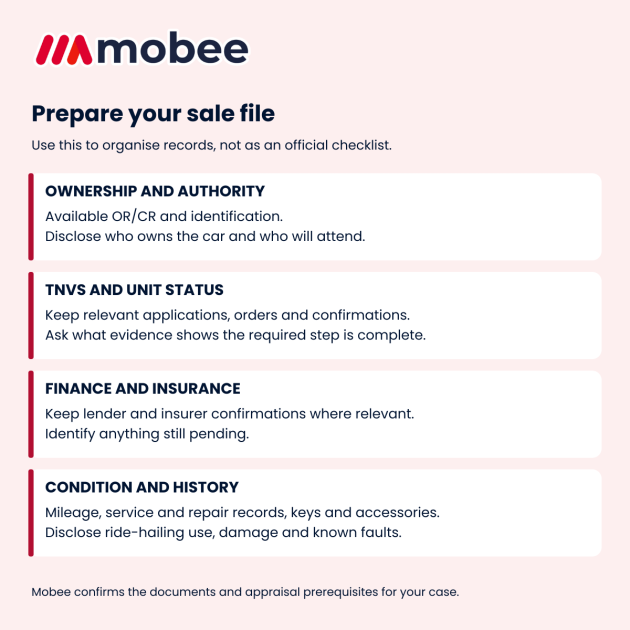
This preparation list helps organise your records; it is not an official exhaustive filing checklist.
5. Confirm Mobee’s appraisal prerequisites
Share the vehicle details and records with Mobee Cars Philippines before requesting an appraisal slot. The applicable TNVS, franchise and unit-status issues must be resolved first. Mobee will identify the documents needed for its review and confirm inspection availability for the vehicle’s location.
A platform confirmation alone may not establish that the relevant agency records are complete. Equally, do not obtain a generic “deactivation” document without first confirming which action applies. Tell the team what remains pending so an appointment is not based on an incorrect assumption.
Mobee offers a free inspection and access to 300+ verified used-car dealers, with no seller fees. Dealer offers arrive within hours after inspection. That offer timing does not include the time needed to resolve regulatory records, lender requirements or missing documents.
6. Review the offer and complete the sale
The offer reflects the particular vehicle, condition, mileage, history and dealer demand. Compare the final amount payable to you, remaining conditions, payment arrangements and handover responsibilities. There is no guaranteed price or guaranteed buyer for every former TNVS car.
Mobee coordinates sale documentation. The Booking Team confirms the responsible payer, payment method, approved account and schedule for your transaction, taking account of completed documents, financing and bank processing. The purchasing dealer handles the LTO ownership transfer. Confirm how completion will be reported and keep the sale, payment and handover records.
For bank transfers, verify receipt through your own bank before releasing the car, keys and original documents; a transfer screenshot alone is insufficient. Read our guide to offers, payment and handover and the applicable Seller Terms before separately accepting a transaction.
If you are comparing selling channels, our selling-options guide explains private listings, direct dealers and Mobee. Confirm that the proposed buyer understands the vehicle’s use history and outstanding conditions.
Frequently asked questions
Is removing my car from a ride-hailing app enough?
It does not, by itself, establish completion of LTFRB or LTO updates. Check the vehicle’s agency records and the relevant platform process separately.
Must every seller use dropping and substitution?
No single process should be assumed for every sale. Dropping and substitution is a unit-replacement process. Ask the LTFRB office handling your records which procedure applies to your intended transaction.
Can I book a Mobee appraisal while TNVS issues are unresolved?
Share your details for initial review, but the applicable TNVS, franchise and unit-status issues must be resolved before the appraisal is scheduled. Ask which evidence is needed for your case.
Will a former ride-hailing car always receive a lower offer?
There is no universal discount in this guide. Dealers assess the particular car’s condition, mileage, history and demand. Disclose its use accurately and compare actual offers.
Does no seller fee cover agency or lender costs?
No seller fees refers to Mobee’s service. Confirm any separate agency, lender, insurance or other transaction obligations that apply to your situation; none is priced or waived by this article.
Start by sharing your vehicle details
Tell Mobee the car’s make, model, year, mileage, location, ownership and TNVS status. The team can explain what needs to be reviewed before a free appraisal is scheduled.
Submit your vehicle details to Mobee Cars Philippines. For questions, use our official contact page or call +63 960 399 9990.
Sources checked on 27 October 2026. Confirm the requirements for your specific records with the receiving office, lender, insurer and platform; this guide does not replace their case-specific instructions.
Have a question about your car?
Ask our team