Documentation
Deed of Sale for a Car in the Philippines: What Sellers Need to Know

A deed of sale for a car in the Philippines is the written record of the sale: who sells, who buys, which car and at what price. The LTO asks for the original to transfer ownership, the seller should report the sale within five working days, and the sale must be registered with the LTO within 20 working days. Facts are from sources accessed on 27 November 2026.
Key facts
- For a private car transfer, the LTO asks for the original deed of sale and the original Certificate of Registration (CR). (LTO Citizen's Charter 2025, section 78)
- For an in-person acknowledgment, the person who signed must appear before the notary public. (2004 Rules on Notarial Practice, quoted in A.C. No. 13287)
- The seller should report the sale within five (5) working days of the transaction. The transaction date is the deed date or the notarial date, whichever is earlier. (LTO Motor Vehicle FAQ)
- Every sale of a motor vehicle must be registered with the LTO within 20 working days of the purchase. (Republic Act No. 10883, section 8)
What is a deed of sale for a car?
It is the written record of the agreement between the seller and the buyer. Under Article 1458 of the Civil Code, in a contract of sale one party agrees to transfer ownership of a particular thing and deliver it, and the other agrees to pay a price for it.
For the Land Transportation Office (LTO) transfer, the deed goes with your CR. The CR identifies the car and its registered owner. The deed records who bought it and for how much. The LTO asks for both originals for a private car.
What details should the deed identify?
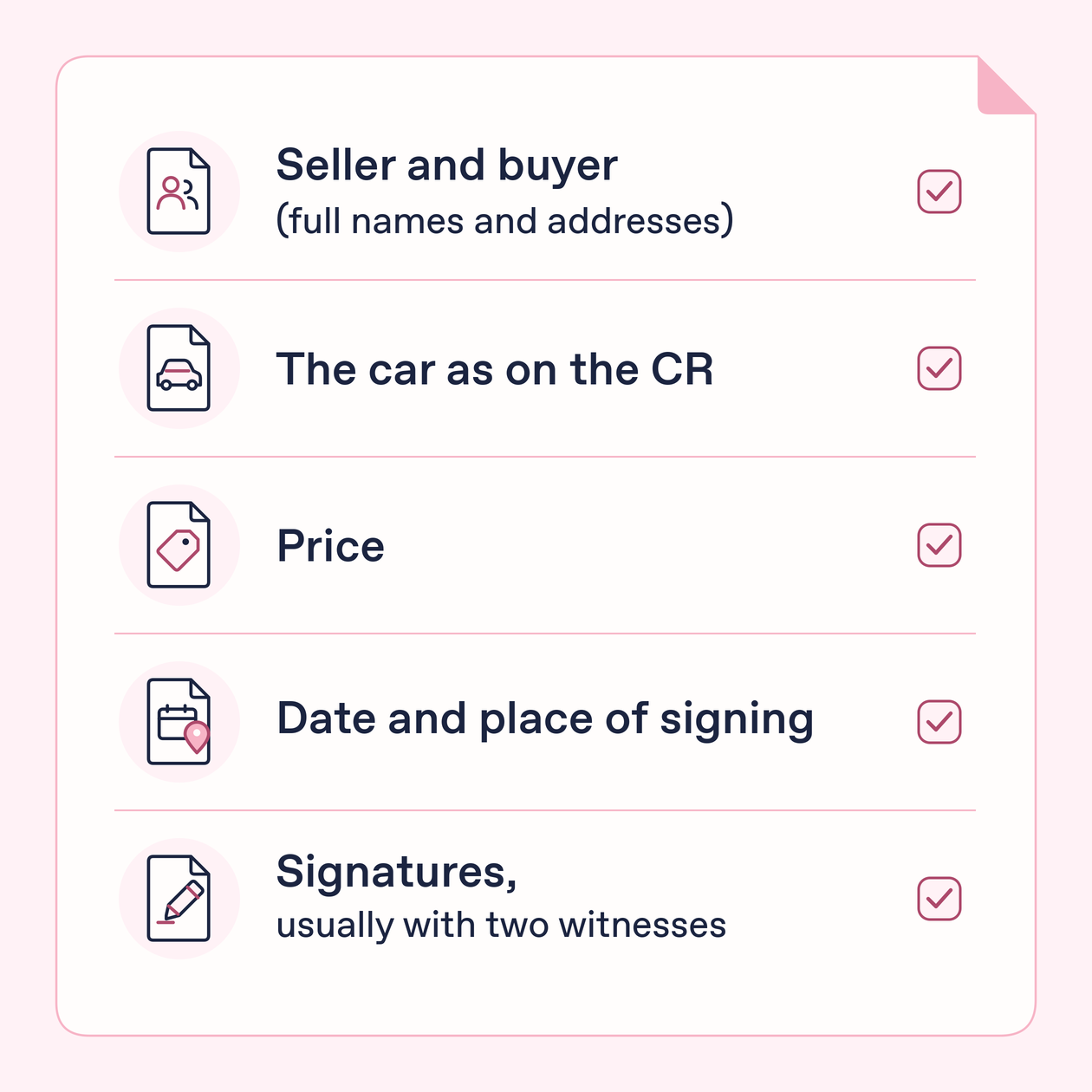
The deed should identify the seller and the buyer, with full names as on their IDs and their addresses. It should describe the car exactly as on the CR: make, model, plate number, engine and chassis numbers, and MV file number. It should also state the price and the date and place of signing. Both parties sign it, usually in front of two witnesses, and then appear before a notary, who records each signer's ID.
Use this quick check before anyone signs:
| Check | Compare it with |
|---|---|
| Seller's full name and address | The seller's ID and the name on the CR |
| Buyer's full name and address | The buyer's ID |
| Make, model and plate number | The CR |
| Engine and chassis numbers | The CR and the numbers on the car itself |
| MV file number | The CR |
| Price, date and place of signing | What you and the buyer agreed |
If the CR is not in the seller's name, read Mobee's guide to selling a car not registered in your name before you prepare the deed. To check the papers themselves, see how to spot a fake OR/CR.
Does the deed of sale need to be notarised?
A deed of sale for a car is normally notarised, and LTO offices generally expect a notarised deed for a transfer of ownership. Have it notarised before you hand over the car, and check with your LTO office. The LTO's reporting rule also refers to the notarial date.
In a conventional in-person acknowledgment, you appear before the notary and declare that you signed the document voluntarily. The notary must know you personally or identify you through competent evidence of identity. That includes at least one current ID from an official agency that shows your photograph and signature.
You cannot send your ID with the buyer instead of going yourself. A notary must not notarise a document if the signatory is not present or cannot be identified.
What should the seller do after signing?
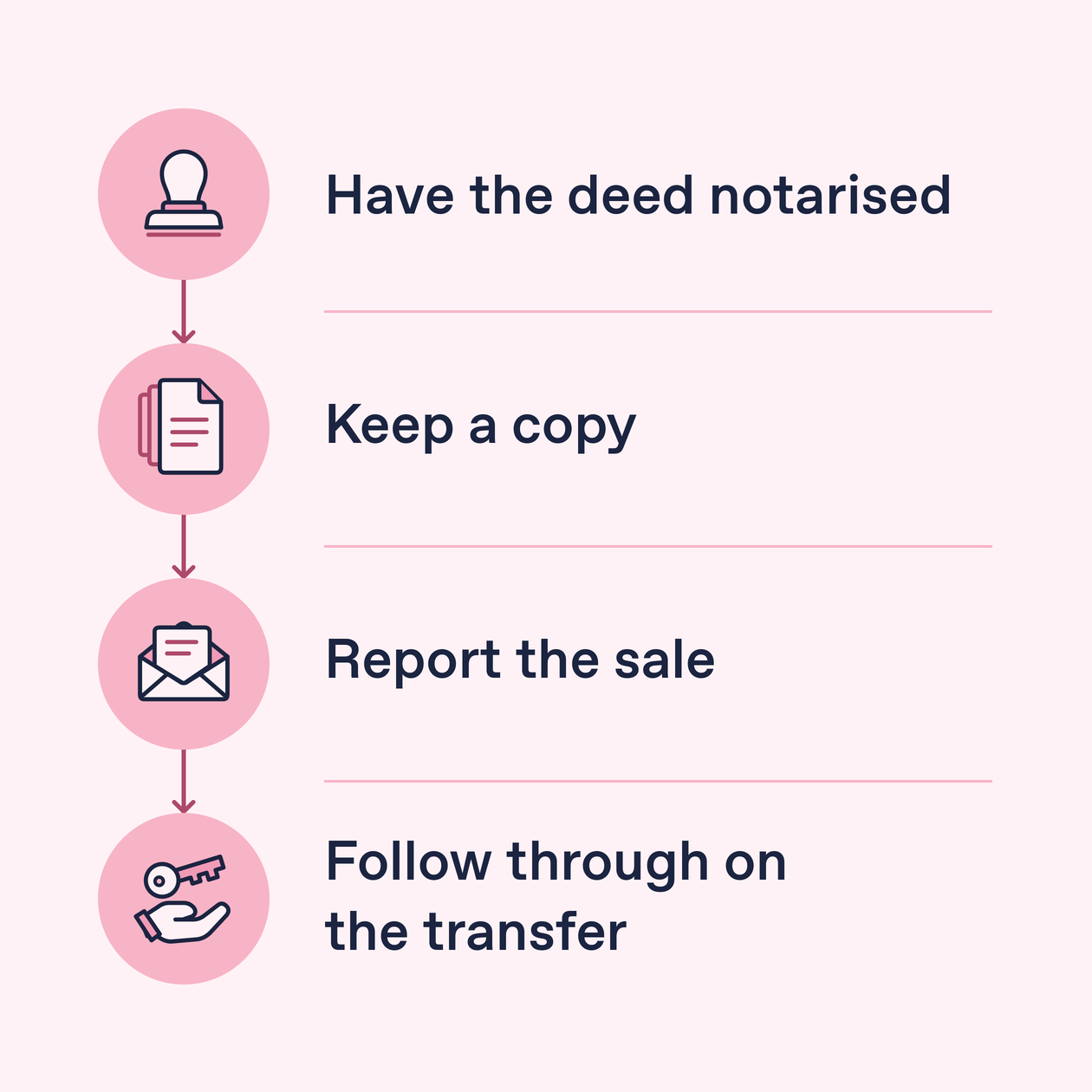
Report the sale and agree who takes the documents to the LTO. Work out the deadlines while the deed is in front of you.
- Work out the transaction date. It is the deed date or the notarial date, whichever is earlier.
- Report the sale. The owner who sold the car should report it within five (5) working days of the transaction. Ask your LTO office how to file.
- Hand over the transfer documents. Agree with the buyer who will take the originals to the LTO, and check the list below together.
- Follow through on the transfer. The sale must be registered with the LTO within 20 working days of the purchase. Ask the buyer to tell you when the updated CR is released.
| Document | Who provides it | Where it goes |
|---|---|---|
| Original deed of sale | The applicant | LTO transfer application |
| Original CR | The registered owner | LTO transfer application |
| Government-issued IDs | The seller and the buyer | Originals shown at the LTO, with a photocopy of each submitted |
| Original PNP-HPG Motor Vehicle Clearance Certificate | PNP Highway Patrol Group | LTO transfer application |
| Original, completed Motor Vehicle Inspection Report (MVIR) | LTO District or Extension Office | LTO transfer application |
| Proof of the electronically transmitted CTPL insurance Certificate of Cover | An accredited insurance company | LTO transfer application |
All authorised LTO District and Extension Offices handle transfers, 8:00 AM to 5:00 PM, under Republic Act No. 4136. For the full checklist and the order of steps, see LTO transfer of ownership: requirements and steps.
The charter lists PHP 50 for the transfer and PHP 10 for the Legal Research Fund, a total of PHP 60. It also lists a late-application fee of PHP 150 when the deed is more than one month old. Confirm both at your LTO office.
Why does the reporting deadline matter to the seller?
Until the transfer is registered, the LTO record can still show you as the owner. Reporting the sale on time, and keeping a copy of the notarised deed, gives you a record of when the car left your hands. Republic Act No. 10883 sets 20 working days for registering the sale, and the LTO FAQ asks the seller to report within five working days.
If the sale does not go ahead after you report it, the LTO says you cancel the report by submitting an affidavit stating that the sale did not push through.
What changes if the car has a chattel mortgage?
Ask your lender and your LTO office what is needed to release the mortgage before you agree a handover date. The LTO charter lists a Cancellation of Chattel Mortgage, stamped and signed by the Registry of Deeds, only for cars acquired through foreclosure. It does not set out the steps for an ordinary financed sale.
Mobee's guide to selling a financed car lists the questions to ask your lender.
How does Mobee help with the paperwork when you sell?
Mobee Cars Philippines is a brand of Mobee Technologies Inc. It arranges a free inspection, presents your car to participating dealers and helps with the paperwork and handover. Mobee does not buy the car itself. Dealers make the offers, and if you accept one and the sale goes ahead, that dealer is the buyer named in the deed of sale.
Your estimate is a starting guide, not a final offer. Dealer offers follow the free inspection.
If the name on the CR differs from the name of the person signing, raise it before you set a handover date. You can get an estimate and arrange a free inspection, ask the Philippines team about your paperwork or read the Seller Terms. For the full process, see how to sell your car in the Philippines.
Related reading: LTO Transfer of Ownership: Requirements and Steps.
Frequently asked questions
Is a "deed of absolute sale" the same thing?
A deed of absolute sale is a written contract in which the seller transfers ownership of the car to the buyer outright, with no conditions such as the seller keeping ownership until the price is paid in full. That is what makes it "absolute", as opposed to a conditional sale. If you are unsure which kind your document is, ask a lawyer or notary before you sign.
Can I sign the deed for someone else?
Only if the owner has given you written authority to sell the car, usually a special power of attorney (SPA) that names the car and authorises its sale. For a company-owned car, the company gives authority through a board resolution or secretary's certificate. An SPA signed abroad must be apostilled or authenticated by a Philippine embassy or consulate. The notary and the LTO will ask to see it.
Who keeps the original deed of sale?
The original deed goes with the LTO transfer application, which the applicant files. Agree with the buyer who will take it, and keep a copy for your records and for reporting the sale.
How long after signing must the transfer be done?
Republic Act No. 10883 requires the sale to be registered with the LTO within 20 working days of the purchase. The LTO charter also lists a PHP 150 late-application fee when the deed is more than one month old.
What if the sale does not go ahead after I report it?
The LTO says the seller cancels the report by submitting an affidavit stating that the sale did not push through. Ask your LTO office where to submit it.
Sources (accessed 27 November 2026): Land Transportation Office, Citizen's Charter 2025 (1st edition), section 78, Miscellaneous Registration Transactions: Transfer of Ownership | Land Transportation Office, iReport mo kay LTO Chief: Motor Vehicle FAQ, "Sale or Disposition" | Republic Act No. 10883 (New Anti-Carnapping Act of 2016), section 8 | Supreme Court E-Library: Ascaño v. Panem, A.C. No. 13287, quoting the 2004 Rules on Notarial Practice | Supreme Court E-Library: Purisima v. Purisima, G.R. No. 200484, quoting Article 1458 of the Civil Code | Mobee Cars Philippines: Sell Your Car in the Philippines | Mobee Cars Philippines: Seller Terms of Service.
Have a question about your car?
Ask our team