Blog > Seller Guide > General
How to Spot Possible Flood Damage in a Used Car in the Philippines

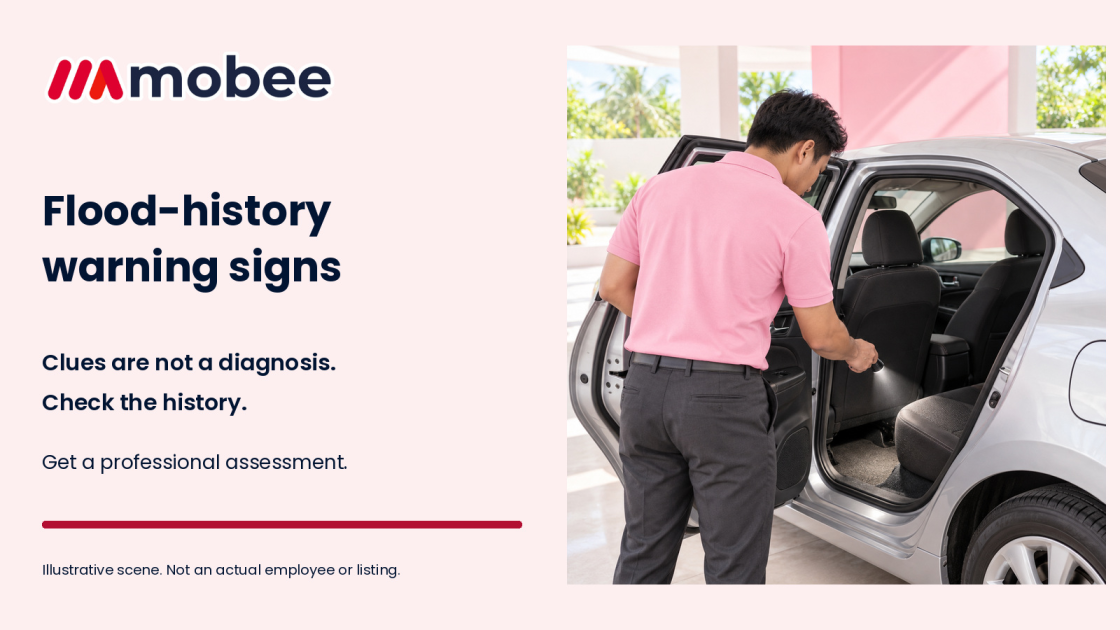
Illustrative Vehicle Appraiser examining a parked car’s cabin; not an actual employee, listing or flood diagnosis.
A musty cabin, watermarks, unusual rust, electrical faults or hidden silt can raise questions about a used car’s history. None is conclusive on its own. Equally, a clean interior and a smooth first impression do not establish that a car has never been flooded.
Use this guide to organise questions and observations before buying or selling a car in the Philippines. Combine the available history with a qualified professional’s assessment, and ask what that assessment cannot establish.
Start with a safety check
If the vehicle has recently flooded, remains wet inside or is suspected to have unresolved flood damage, do not start the engine, operate accessories or test-drive it to see whether it works. Arrange professional assessment and suitable transport. State Farm’s flood guidance explains why starting an apparently dry vehicle can still cause damage.
Do not open electrical modules, disconnect batteries, remove airbag components or handle high-voltage parts as a DIY check. For a hybrid or electric vehicle, contact a qualified technician familiar with that model. If you see smoke or other signs of an immediate hazard, keep away and seek emergency help.
The observations below are for accessible areas of a stationary vehicle that is safe to approach. They are not instructions to enter floodwater, crawl underneath an unsupported car or dismantle its interior. For immediate flood-response guidance, see our flood-season safety article.
Five warning signs worth investigating
1. Musty smells or strong deodoriser
An unusual damp smell, or a heavy fragrance masking it, warrants a question about water exposure and cleaning. NHTSA identifies these as possible clues. Ask when the smell began and whether any leak, flood event or interior repair was documented; smell alone is not a diagnosis.
2. Watermarks or mismatched interior fabric
Look at visible carpet, seat fabric and boot trim for staining or unexplained replacement. The FTC includes loose, stained or mismatched carpet among flood-warning signs. Ask why materials were changed and request the relevant repair records instead of assuming that new upholstery proves either damage or recovery.
3. Unusual rust in sheltered areas
Unexplained corrosion on visible interior metal or fittings deserves professional attention. Its location and extent matter; ordinary age, environment and other moisture exposure can complicate interpretation. Do not treat a single rusty screw as proof of a flood or a lack of rust as an all-clear.
4. Reported electrical faults
Ask about intermittent warning lights, malfunctioning controls and repeated electrical repairs. Toyota’s flood-inspection bulletin explains that water exposure can damage electrical components and cause corrosion-related faults. These symptoms also require diagnosis; do not power up a suspected flooded vehicle to reproduce them.
5. Silt or debris where it is difficult to clean
Visible mud or sediment in sheltered cabin or boot areas can justify a closer inspection. Note what you can see without taking the car apart. Ask a professional to assess inaccessible areas and whether the residue is consistent with the history provided.
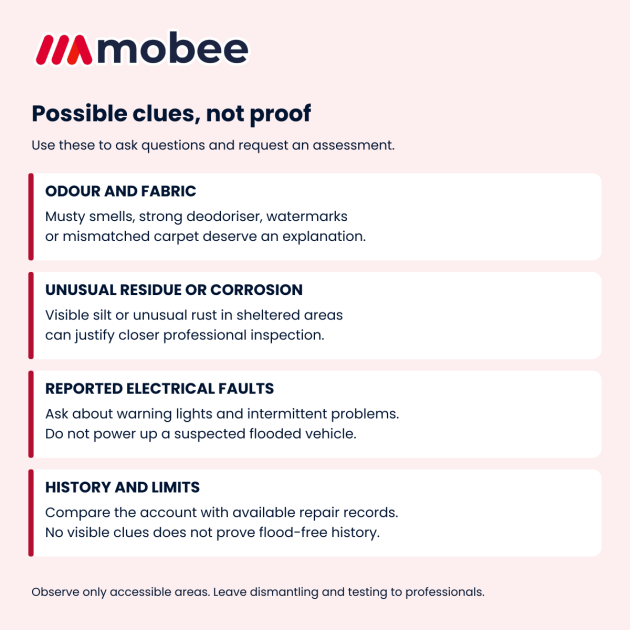
Possible clues prompt questions and professional assessment; they do not prove a flood history.
Check the story against the records
Ask the seller direct, neutral questions and keep the answers with the documents you receive:
- Has water ever entered the cabin, engine area or other vehicle systems? When and where?
- What inspection, drying, repair or replacement work followed? Who carried it out?
- Are there dated invoices, inspection reports, photographs or insurance correspondence available?
- What faults remain, and which parts or areas were not checked?
Look for agreement between the vehicle, the account and the available records. Missing records leave uncertainty; they do not automatically prove fraud. Keep sensitive personal information out of public listings and share only what is needed through an appropriate channel.
Check that the registration details match the actual vehicle. Our OR/CR checking guide covers document verification, but registration paperwork is not a substitute for a condition assessment.
Get an independent professional assessment before buying
Choose a qualified mechanic or the relevant manufacturer’s service centre and explain the specific concerns. Ask for a written report that identifies the vehicle, records the findings and states the inspection’s limits. A service history or vehicle-history report does not replace an independent inspection, as the FTC’s used-car guidance explains.
Ask which concerns need specialist electrical or model-specific assessment, what repairs are recommended and whether the vehicle should be operated. Avoid committing to a purchase while significant safety questions remain unanswered. If the seller will not permit a reasonable independent inspection, consider another vehicle.
For a Ford in the Philippines, Ford’s calamity-support page directs owners to a service assessment or their nearest dealer. Confirm the available service directly; this guide does not promise a current discount or extend a manufacturer’s programme to other brands.
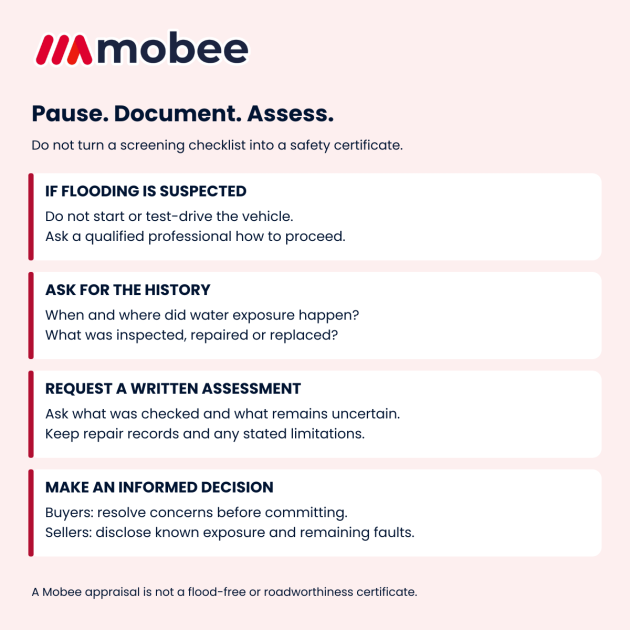
Pause, document the history and obtain an assessment before deciding what to do next.
If you are selling a car with known flood exposure
Tell the prospective buyer and appraiser what you know about the exposure, repairs and remaining faults. Provide available records and explain any gaps. Cleaning the interior is not evidence that underlying damage has been repaired; avoid presenting an uncertain history as “flood-free”.
If you want to sell through Mobee Cars Philippines, share the vehicle’s details and known condition before arranging an appointment. Ask the team whether it can proceed with that vehicle and what preparation is needed. This article does not promise acceptance of every flood-affected car, a particular repair outcome or a fixed resale value.
Mobee offers free inspection, no seller fees and access to 300+ verified used-car dealers. Dealer offers arrive within hours after inspection. A sale appraisal is not a flood-free or roadworthiness certificate, and it does not replace any specialist assessment the vehicle needs.
Frequently asked questions
Can I tell from photos whether a car was flooded?
Photos can help identify questions, but they cannot establish the condition of concealed components or a complete history. Ask for records and a professional assessment of the actual car.
Does a clean scan or a running engine prove the car is safe?
No single observation establishes that. Ask the inspecting professional what was tested, what was inaccessible and what uncertainty remains. Do not test-drive a vehicle with suspected unresolved flood damage.
Can a repaired flooded car be guaranteed trouble-free?
This guide makes no such guarantee. Toyota’s bulletin calls for individual assessment based on exposure, and repair history must be considered alongside current findings. Ask the relevant professional about unresolved risks for that particular vehicle.
Can an overseas vehicle-history database verify a Philippine car?
Do not assume it provides complete Philippine records. The US sources linked here inform the physical warning signs and inspection precautions; their title, database, warranty and insurance rules are not presented as Philippine requirements.
Discuss your car’s condition with Mobee
Submit your vehicle details to Mobee Cars Philippines, including any known flood exposure or repairs. For questions, use our official contact page or call +63 960 399 9990.
Sources checked on 27 October 2026. This is a screening guide, not a diagnosis, repair instruction or safety certificate.
Was this article helpful?
How to Spot a Fake ORCR in the Philippines
17 April 2025 Mobee Cars PhilippinesVoluntarily Surrendering a Car to the Bank in the Philippines: What to Check First
17 May 2025 Mobee Cars PhilippinesHow to Check Flood-Prone Areas in the Philippines: Official Resources for Car Owners
15 November 2024 Mobee Cars PhilippinesNo comment yet. Be the first to comment.