Defensive Driving in the Philippines: Practical Habits for Safer Journeys

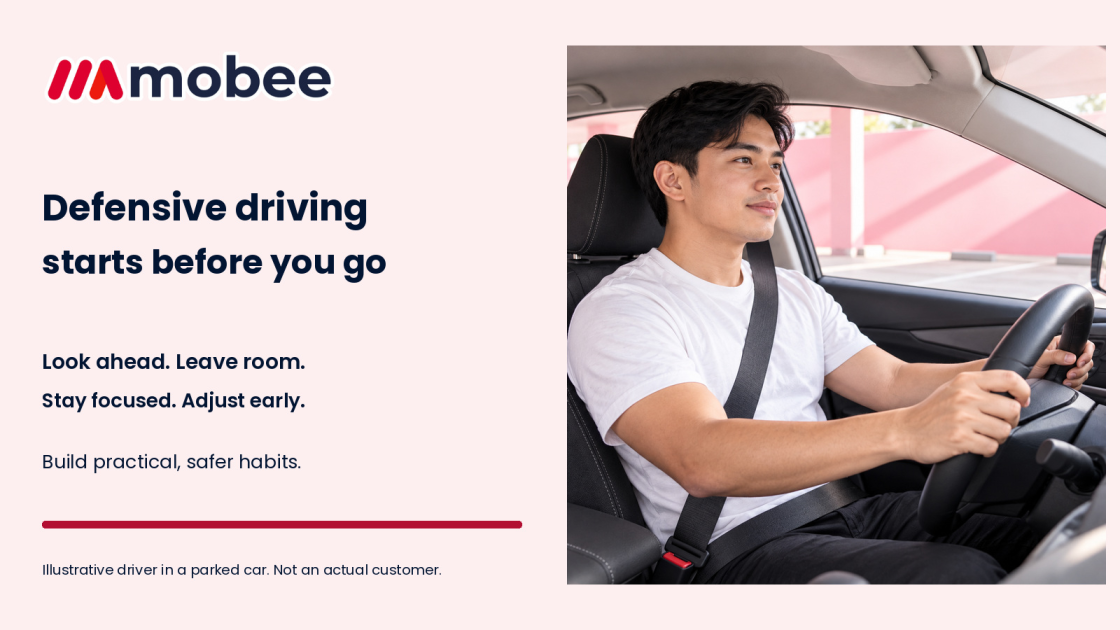
Illustrative driver wearing a seat belt in a parked car; not an actual customer or driving-course demonstration.
Defensive driving means noticing possible problems early and leaving yourself time and space to respond. It includes looking beyond the vehicle ahead, keeping a suitable gap, adjusting to conditions and protecting your attention.
It does not mean predicting every driver’s actions or guaranteeing that a crash cannot happen. The World Health Organization’s road-safety guidance treats safe speeds, vehicles, roads and road users as parts of the same system. Good habits matter alongside safe infrastructure and everyone else’s behaviour.
1. Prepare before the car moves
Set your seat and mirrors so you can see and operate the controls comfortably. Wear your seat belt and check that passengers use the appropriate restraints. Arrange navigation, music and essential items before moving, so routine adjustments do not compete with driving.
Check the vehicle’s condition and follow its maintenance guidance. Tires, lights and wipers deserve particular attention before wet-weather travel. Toyota Motor Philippines’ rainy-day guidance highlights these checks and the need to adjust driving when grip or visibility worsens.
If a fault affects safe operation, have it assessed before driving. Familiarise yourself with the controls and the owner’s manual; a warning or unfamiliar feature should not be explored for the first time in busy traffic.
2. Look ahead, around and into blind spots
Watch the wider scene instead of concentrating only on the car directly in front. Look for crossings, side roads, parked vehicles, people approaching the roadside and changes in traffic flow. Use mirrors and appropriate blind-spot checks before changing position.
In a Philippine city street, a stopped jeepney or bus is a reason to anticipate passengers entering or leaving the roadside area. Near a school or market, be ready for people whose view of traffic is obstructed. These are examples of observations to practise, not a prediction that a particular road user will make a mistake.
LTO’s defensive-driving learning topics include perception, safe positioning, blind spots and sharing the road. Use LTO’s official eLearning resources as a starting point, with practical instruction where needed.
3. Leave room to react
Avoid following so closely that a routine stop ahead becomes an emergency for you. The space you need changes with speed, visibility, road grip, vehicle condition and load. Increase the margin when conditions worsen or the view ahead is blocked.
Do not treat a single “three-second rule” as a guarantee. LTO’s driver-manual guidance describes a time-gap approach as an informal reaction buffer that requires adjustment. Ask a qualified instructor how to judge an appropriate gap for your vehicle and the conditions, and keep reassessing it.
If another vehicle enters the gap, ease back smoothly when safe to restore space. Do not accelerate to defend the gap or brake abruptly to punish a driver behind. Your aim is room to respond, not to win a position.
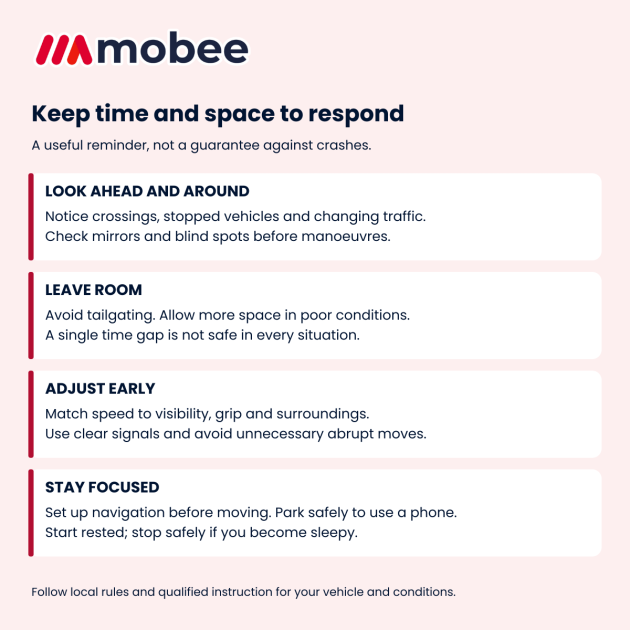
Keep time and space to respond: observe, leave room, adjust early and stay focused.
4. Adjust speed and communicate clearly
Follow applicable traffic rules and posted limits, while also considering visibility, grip, pedestrians and the road layout. A posted maximum is not a target for every condition. WHO identifies speed as a factor in both crash likelihood and severity.
Signal your intentions, check before moving and avoid unnecessary abrupt changes. If you miss a turn or exit, continue to a suitable legal route rather than making a sudden manoeuvre. Stay calm when another driver behaves aggressively and avoid a contest of speed or position.
In rain, reduce speed as conditions require and allow more room. If you cannot see or proceed safely, seek an appropriate safe place to stop; do not stop in a live traffic lane merely to wait out the weather. Plan ahead using official flood-risk resources, and do not drive into floodwater.
Our flood-season safety guide covers the different problem of flood exposure and a potentially flooded vehicle. A driver-assistance feature is not permission to continue into conditions you cannot safely assess.
5. Keep distractions out of the driving task
If you need to read a message, change a route or deal with something that takes your attention away, find a safe place and park first. Waiting at a red light is not the same as being safely parked away from traffic.
NHTSA’s distraction guidance recommends parking before reading or sending a message and setting notifications aside. A passenger can help with navigation or messages while you focus on driving. Keep conversations and other activities from absorbing the attention you need for the road.
Hands-free does not mean distraction-free. WHO notes that phone conversations can still impair driving even when the device is not being held. Choose the safer time to have the conversation.
6. Start rested and recognise when to stop
Do not begin a journey when you are too sleepy or otherwise impaired to drive safely. Plan rest opportunities and an alternative driver or transport when needed. If sleepiness develops, stop at a suitable safe location instead of trying to push through.
Check medicine labels for warnings about drowsiness or driving, and ask a pharmacist or clinician if you are unsure. Do not drive after drinking alcohol. NHTSA’s drowsy-driving guidance explains why coffee alone is not a reliable answer to serious sleep loss.
Turn the habits into a routine
Before leaving, ask yourself:
- Am I rested and able to concentrate?
- Is the vehicle ready, and are occupants properly restrained?
- Have I set up navigation and put distractions aside?
- What weather, road or traffic conditions might require a different plan?
After a journey, reflect on moments when you felt rushed or ran out of space. A qualified driving instructor can help you practise observation, positioning and judgement in a supervised setting. A course should build practical skills; this guide does not promise a particular percentage reduction in crashes or insurance costs.
Frequently asked questions
Is defensive driving just driving slowly?
No. It combines observation, space, appropriate speed, communication and attention. Driving unpredictably or ignoring road conditions is not made safe simply by using a low speed.
Does one time gap work in every situation?
No. Conditions and vehicle characteristics affect the margin needed. Treat a time-gap method as a tool to discuss and practise with a qualified instructor, not a universal safety certificate.
Can safety technology replace these habits?
No. Learn the functions and limits described in your own vehicle’s manual and remain responsible for observation and control. Features differ between vehicles and may not respond to every situation.
When you are ready to sell your car
Mobee Cars Philippines offers a free inspection, no seller fees and access to 300+ verified used-car dealers. Offers arrive within hours after inspection. Keep service records and disclose known faults; an appraisal is not a substitute for resolving a safety problem before driving.
Submit your vehicle details or use our official contact page. For questions, call +63 960 399 9990.
Sources checked on 27 October 2026. This is general driving education, not a substitute for qualified practical instruction, the vehicle manual or applicable road rules.
Was this article helpful?
How to Spot a Fake ORCR in the Philippines
17 April 2025 Mobee Cars PhilippinesVoluntarily Surrendering a Car to the Bank in the Philippines: What to Check First
17 May 2025 Mobee Cars PhilippinesHow to Check Flood-Prone Areas in the Philippines: Official Resources for Car Owners
15 November 2024 Mobee Cars PhilippinesNo comment yet. Be the first to comment.