
2024 Vehicle Sales in the Philippines: Monthly Results and Regional Context

Fictional showroom illustration; not a photograph of a particular dealership or an event in 2024.
The Philippines recorded growth in its reported new-vehicle sales during 2024, but the year is best understood through dated, clearly defined data. Monthly sales did not rise without interruption, and a forecast made partway through the year was not the same thing as the final result.
This historical review covers 2024. It presents the ASEAN Automotive Federation’s published Philippine monthly series, CAMPI’s first-half brand snapshot and regional reports with their own definitions. It does not describe October 2026 demand or count used-car transactions.
What the figures measure
The ASEAN Automotive Federation (AAF) publishes motor-vehicle sales separately from motorcycles and scooters. The table below uses its December 2024 motor-vehicle sheet’s Philippine row, consistently from January through December. It is a published reporting series, not a claim that every vehicle transaction in the country was captured.
Keep new-vehicle reporting distinct from secondhand transactions, company sales and vehicle registrations. Different reports can cover different participants, transaction stages or revisions. A company’s wholesale deliveries and its retail sales are also different measures; they should not be substituted for each other.
Philippine monthly sales in 2024
Units below are reproduced from the AAF December 2024 series. The full-year sum is 467,253, compared with its 2023 total of 429,807; the calculated increase rounds to 8.7%.
2024 month: January
Vehicles — AAF published series: 34,060
2024 month: February
Vehicles — AAF published series: 38,072
2024 month: March
Vehicles — AAF published series: 37,474
2024 month: April
Vehicles — AAF published series: 37,314
2024 month: May
Vehicles — AAF published series: 40,271
2024 month: June
Vehicles — AAF published series: 39,088
2024 month: July
Vehicles — AAF published series: 39,331
2024 month: August
Vehicles — AAF published series: 39,155
2024 month: September
Vehicles — AAF published series: 39,542
2024 month: October
Vehicles — AAF published series: 40,004
2024 month: November
Vehicles — AAF published series: 40,898
2024 month: December
Vehicles — AAF published series: 42,044
2024 month: Full-year sum
Vehicles — AAF published series: 467,253
Source note: the AAF sheet’s total-column heading still says “YTD Sep”, although it contains all twelve months and their full-year sum. This table labels that sum explicitly. Figures are historical and source-specific.
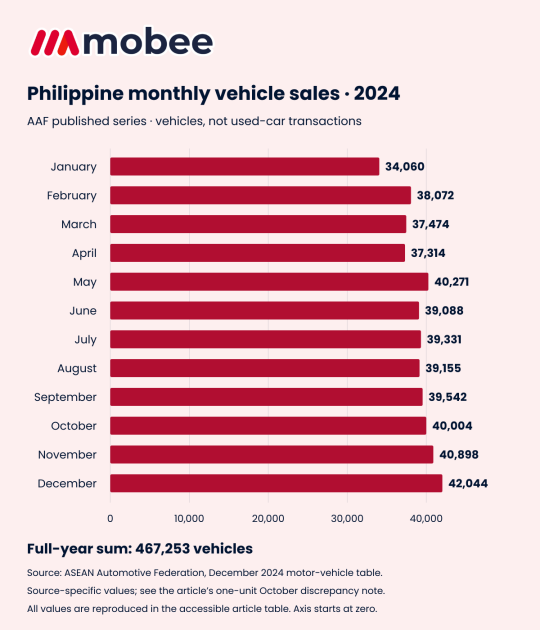
Monthly units from the AAF December 2024 Philippine series. The horizontal axis starts at zero; every value is also available in the text table.
Do not silently combine this series with another release: CAMPI’s September and October cumulative reports imply October sales of 40,003, while AAF prints 40,004. That produces a one-unit difference in the January–October total. We retain the AAF series consistently and disclose the difference rather than invent a correction.
The first-half picture and key brands
CAMPI’s release dated 1 July 2024 reports 226,279 vehicles through June, up 11.8% from 202,415 in the same period of 2023. That matches the sum of the first six monthly figures above. The release also describes a month-on-month decline in June, so a positive half-year result should not be described as uninterrupted monthly growth.
For the same first-half period and reporting scope, CAMPI gives these leading company shares:
- Toyota Motor Philippines Corporation: 46.12%.
- Mitsubishi Motors Philippines Corporation: 18.83%.
- Ford Group Philippines: 6.39%.
These are first-half company shares in CAMPI’s report, not full-year used-car market shares. They do not establish model-level reliability, resale value or why a buyer chose a particular vehicle. The original article’s approximate brand figures should not be treated as a current ranking.
Why full-year company reports need their own labels
GT Capital’s full-year 2024 results briefing reports Toyota Motor Philippines retail volume of 218,019 units and wholesale volume of 218,031. Its industry retail figure is 473,842, with a footnote including BYD’s full-year sales. That wider industry figure should not replace the AAF denominator without explaining the different scope.
Ford’s own statement dated 24 February 2025 reports 27,997 Philippine sales for 2024. It is a useful company-level result, but it is not a complete industry ranking or a measure of used Ford transactions.
When comparing market shares, use the same period and denominator. Do not divide one company’s retail figure by a different wholesale or differently scoped industry total and present the result as an official share.
Malaysia and Indonesia: 2024 context, with different measures
The Malaysian Automotive Association’s 21 January 2025 review reports 816,747 new-vehicle registrations, or Total Industry Volume, for 2024, up 2.1% from 799,821 in 2023. This is Malaysia’s annual registration measure, not a count of used-car sales.
GAIKINDO’s review dated 19 February 2025 reports Indonesian 2024 wholesales of 865,723 vehicles, down 13.9% from 2023. It separately reports retail sales of 889,680, down 10.9%. Wholesales mean manufacturer-to-dealer movements in that report; retail sales refer to dealer-to-consumer sales.
The three markets provide useful regional context, but their headline counts should not be treated as a perfectly comparable measure of consumer demand. Country size, reporting coverage and the transaction stage differ. These figures also do not support the original article’s claim that all three markets were growing at the stated first-half rates.
A target is not an achieved result
A forecast expresses an expectation for a specified future period. An actual result records what a reporting series subsequently measured. Preserve both the date and scope when discussing either one; do not leave a historical article saying that already-completed months remain unreported.
For this refresh, the twelve-month table replaces the unfinished 2024 outlook. No 2025 or 2026 forecast is presented as an achieved 2024 total, and no growth assumption is extended into the present.
What this history means for a used-car seller
New-vehicle sales history provides industry context. On its own, it cannot determine the price or selling time of an individual used car. Your vehicle’s year, variant, condition, records and actual buyer offers remain separate evidence.
Our used-car market guide explains the difference between asking prices, offers and transactions. Our resale-value guide applies that distinction to a particular vehicle rather than a blanket brand ranking.
If you are selling today, Mobee Cars Philippines connects owners with 300+ verified used-car dealers, with free inspection, no seller fees and offers within hours after inspection. These are current service facts, separate from the historical sales data in this article. An initial estimate is not a guaranteed final offer, and an offer is distinct from completed payment and handover.
Submit your car details or contact Mobee Cars Philippines at +63 960 399 9990. Confirm the offer and transaction terms for your vehicle rather than relying on a historical industry headline.
Historical data and source scope reviewed on 27 October 2026. This page remains a 2024 retrospective; it is not a current sales forecast, vehicle valuation or investment recommendation.
Was this article helpful?
How to Spot a Fake ORCR in the Philippines
17 April 2025 Mobee Cars PhilippinesVoluntarily Surrendering a Car to the Bank in the Philippines: What to Check First
17 May 2025 Mobee Cars PhilippinesHow to Check Flood-Prone Areas in the Philippines: Official Resources for Car Owners
15 November 2024 Mobee Cars PhilippinesNo comment yet. Be the first to comment.