10 Used Cars to Compare in the Philippines: A Practical Model Guide

Fictional vehicles illustrate different body styles; they are not exact models, actual Mobee stock or a sales ranking.
A useful used-car shortlist starts with how you will use the car, the exact version on offer and its condition. A familiar model name alone cannot tell you whether a particular vehicle is fairly priced, well maintained or suitable for your family.
This guide revisits the ten models in our original 2025 article. It is a comparison list, not a ranking of Philippine used-car sales, reliability or resale value. Updated on 27 October 2026, it separates model information from the checks needed on an individual used vehicle.
How to use this list
The manufacturer examples below were checked on 27 October 2026. Most describe current new-car versions, not every older car with the same badge. Hyundai Accent information is explicitly historical. Match the model year, generation, variant, engine, transmission and equipment to the vehicle’s own records and the appropriate brochure or manual.
Treat the suggested uses and checks as an editorial comparison framework. They are not a diagnosis, inspection result or promise of low running costs. Get an independent inspection and written repair estimates before relying on a used car’s advertised condition.
The ten models at a glance
Read each row with the detailed notes below. The order follows our original article; it does not indicate which model sells most or holds its value best.
Model from original list: Toyota Vios
Comparison category: Sedan
Particular check: Exact transmission and service history
Model from original list: Mitsubishi Mirage G4
Comparison category: Sedan
Particular check: Year-specific equipment and passenger fit
Model from original list: Toyota Fortuner
Comparison category: SUV
Particular check: 4×2/4×4, access and parking fit
Model from original list: Toyota Innova
Comparison category: MPV
Particular check: Actual seating arrangement and generation
Model from original list: Hyundai Accent
Comparison category: Historical sedan example
Particular check: Engine, transmission and airbag specification
Model from original list: Nissan Navara
Comparison category: Pickup
Particular check: Prior use and exact load/drivetrain limits
Model from original list: Honda City
Comparison category: Sedan
Particular check: Distinguish hatchback and model-year equipment
Model from original list: Toyota Wigo
Comparison category: Hatchback
Particular check: Generation, transmission and luggage needs
Model from original list: Mitsubishi Montero Sport
Comparison category: SUV
Particular check: 2WD/4WD and variant-specific equipment
Model from original list: Honda Civic
Comparison category: Sedan
Particular check: Generation, powertrain and modifications
1. Toyota Vios
Consider the Vios when you want to compare a sedan for everyday journeys. Toyota Philippines’ current Vios page lists both manual and continuously variable transmission (CVT) versions, illustrating why “Vios” alone is not a complete specification. Check the exact transmission, service history, cabin space and boot access on the used unit.
A model’s reputation is not proof of the car’s past use. Ask about previous ownership and use, compare the records with its mileage and condition, and obtain quotes for work identified during inspection. Do not assume all variants have the same features.
2. Mitsubishi Mirage G4
The Mirage G4 is the sedan in this comparison, distinct from the Mirage hatchback. Mitsubishi’s current Philippine page specifies a 1.2-litre gasoline engine and lists manual and CVT variants. For your shortlist, check passenger comfort, luggage needs and whether the actual car’s performance suits your usual journeys.
Avoid turning engine size into a guaranteed fuel bill or maintenance cost. Budget using the particular vehicle, your distance travelled and inspection findings. Check the model year’s equipment rather than applying the latest page’s safety features to every older unit.
3. Toyota Fortuner
The Fortuner is an SUV option for comparison. Toyota’s current Philippine range includes 4×2 and 4×4 versions, so drivetrain is an important distinction when identifying a used example. Confirm its exact specification, parking fit and passenger access; a larger vehicle is not automatically the right choice for your daily route.
Inspect the actual seating and luggage arrangement with your usual passengers and bags in mind. Obtain maintenance, tyre and insurance quotations for that version instead of assuming a fixed cost advantage or penalty from its body style.
4. Toyota Innova
The Innova is an MPV to consider when passenger arrangement matters. Toyota’s current Innova page shows that configurations differ: it describes captain seats for the 2.8 V automatic and eight seats for the XE automatic. These are specific examples, not a promise that every used Innova has the same layout.
Check the actual seats, seat belts, access and luggage room. Identify the generation and powertrain carefully, and do not substitute specifications for a different Innova-related model. Past family, business or other use should be checked through records and inspection, not guessed from the badge.
5. Hyundai Accent
For the Accent, model-year identification is especially important. Hyundai Commonwealth’s page explicitly describes the 2019 Accent sedan and lists gasoline and diesel variants, including versions labelled with and without airbags. It is a historical reference, not evidence of current new-stock availability or today’s pricing.
Confirm the engine, transmission and actual safety equipment for the specific unit. Do not copy equipment from an overseas brochure or another trim. Request the correct manual and records, and have equipment and condition checked before buying; a nameplate alone does not establish a safety specification.
6. Nissan Navara
The Navara is the pickup in this list. Nissan Philippines’ current page describes a 2.5-litre turbo-diesel engine with manual and automatic options, and qualifies some output figures by variant. If you need a pickup bed, compare its actual dimensions, load requirements and the exact version’s manufacturer limits.
Check parking space, passenger needs, prior work use and any modifications. Do not assume every Navara has the same drivetrain, payload or assistance features. An inspection should assess the individual vehicle rather than infer condition from a rugged appearance.
7. Honda City
Keep the City sedan distinct from the City Hatchback. Honda Philippines’ 17 October 2026 announcement treats them as separate models and describes a 1.5-litre engine with CVT for the newly announced versions. This recent update is not a specification sheet for an older used City.
Compare the precise year and variant, cabin and luggage access, service records and equipment. If a listing claims Honda SENSING or another feature, verify that it belongs to that particular version and is functioning; do not infer it from the latest model’s advertisement.
8. Toyota Wigo
The Wigo provides a hatchback option for comparison. Toyota Philippines’ current Wigo range lists CVT and manual versions. Inspect how the rear hatch and seating arrangement work with the passengers and luggage you actually carry, and check whether the car fits your parking space and routine.
A smaller car does not automatically make a neglected example cheaper to own. Compare its purchase price plus identified repairs, tyres, servicing and insurance. Use the correct generation’s specification rather than transferring equipment or transmission details between years.
9. Mitsubishi Montero Sport
The original list’s “Montero” refers here to the Montero Sport SUV. Mitsubishi Philippines’ current range separates 2WD and 4WD versions and lists different equipment by trim. That makes precise variant identification essential when comparing an older unit.
Check passenger and luggage fit, maintenance records and the condition of fitted systems. A feature shown on a current high-grade model should not be assumed present on an older or lower-grade car. Obtain vehicle-specific ownership-cost quotes before deciding.
10. Honda Civic
The Civic completes the original list. Honda’s October 2026 announcement includes the Civic RS e:HEV, showing how a long-running nameplate can include substantially different powertrains over time. It does not mean every used Civic is a hybrid or shares that model’s equipment.
Identify the exact generation, engine, transmission and any modifications. Compare servicing requirements and quotations for that vehicle, including specialist assessment where its powertrain requires it. Styling and reputation should not replace records, inspection or a realistic budget.
Compare the vehicle, not only the nameplate
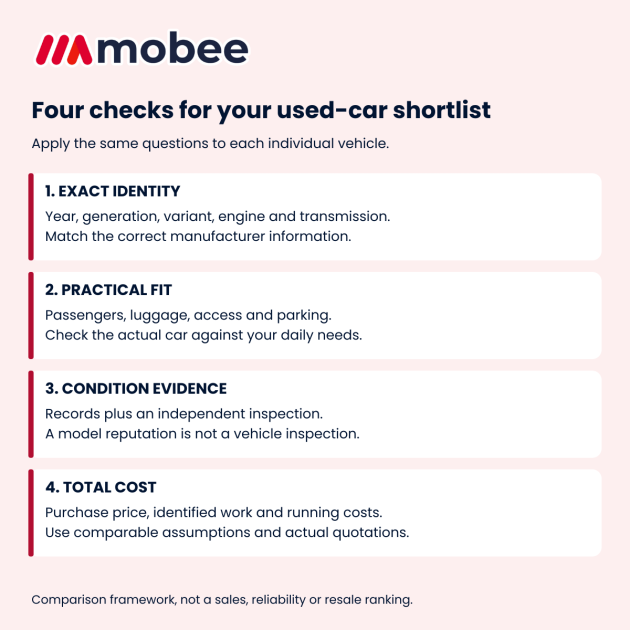
Use the same four checks for each shortlisted vehicle: identity, practical fit, condition and total cost. The list does not score or rank models.
- Identity: record the exact year, generation, variant, engine and transmission, then match equipment to appropriate manufacturer information.
- Practical fit: try passenger access, seating, luggage space and parking dimensions against your actual needs.
- Condition: examine service and ownership records and obtain an independent inspection. Do not treat an advertisement or model reputation as verification.
- Total cost: combine the actual purchase quotation with identified work, financing charges if relevant, insurance and expected running costs. Compare like-for-like assumptions.
Our first-time used-car buyer checklist covers records, inspection and written terms. If resale value is part of your decision, our brand and resale-value guide explains why relevant vehicle details and actual offers matter more than a universal brand ranking.
Selling your current car through Mobee Cars Philippines
Mobee Cars Philippines helps owners sell through 300+ verified used-car dealers, with free inspection, no seller fees and offers within hours after inspection. The service is for arranging dealer offers for your vehicle; this comparison does not advertise the ten models as Mobee retail stock.
An initial estimate is not a guaranteed final offer, and receiving an offer is distinct from completed payment and handover. Submit your car details or contact Mobee Cars Philippines at +63 960 399 9990 to discuss your next step.
Model sources checked on 27 October 2026. No verified national used-car sales ranking, model reliability study or guaranteed resale-value order is asserted. Confirm the exact vehicle’s specifications, condition and terms before making a decision.
Was this article helpful?
How to Spot a Fake ORCR in the Philippines
17 April 2025 Mobee Cars PhilippinesVoluntarily Surrendering a Car to the Bank in the Philippines: What to Check First
17 May 2025 Mobee Cars PhilippinesHow to Check Flood-Prone Areas in the Philippines: Official Resources for Car Owners
15 November 2024 Mobee Cars PhilippinesNo comment yet. Be the first to comment.