
Why Face-to-Face Interaction Still Matters When Selling or Buying a Car

Illustration of a seller conversation; fictional people and vehicle, not an actual Mobee customer visit.
Online tools help you gather car details, compare options and prepare questions. A conversation beside the actual vehicle serves a different purpose: it gives you a chance to ask about its condition, understand an inspection finding and clarify what an offer includes.
For buyers and sellers in the Philippines, the useful approach is to combine those steps. Meeting someone is not proof that a car is sound or a transaction is safe. Human support works best when explanations are backed by records, appropriate checks and clear written terms.
What the EY research actually says
EY’s release dated 4 January 2024 reported that 61% of surveyed car buyers preferred completing a purchase at a dealership, compared with 54% in 2021. It described research covering 15,000 consumers across 20 countries. This was a statement about preferences, not the percentage of Philippine sales completed in person.
EY’s published 2023 methodology dates that survey to March 2023 and lists its 20 countries; the Philippines is not among them. Its findings provide international context, not a Philippine consumer statistic.
The figure is also historical. EY’s 9 December 2025 release reports that 41% of buyers in its global study preferred completing a purchase in person. Different survey waves should be read in their own context. Neither release establishes a current percentage for Filipino buyers. Treat these findings as dated international context.
The practical lesson is narrower: online preparation and a useful conversation can complement each other. Choose the steps that help you verify the particular car and transaction, rather than treating a survey preference as a guarantee.
A conversation can turn a vague claim into a checkable question
“Well maintained” is a starting point for a discussion, not a complete condition report. Ask which work was done, when it was done and what record supports it. If a seller describes a repair, ask whether the available invoice or workshop record relates to this vehicle.
For a seller, the same principle applies to an offer. Ask what vehicle details and inspection findings it assumes, whether any amount is still conditional and what could change before the transaction is completed. If an explanation is unclear, ask for it in plain language and keep the written response.
A friendly meeting can make questions easier to ask. It does not replace checking the other party through an appropriate official channel, examining available records or confirming the agreed terms.
Seeing the car is useful; an inspection has a separate role
A viewing lets a buyer assess practical fit: seating, access, luggage space and controls. It also gives the owner an opportunity to point out known issues. A brief look or conversation cannot reveal every mechanical problem.
The US Federal Trade Commission’s used-car guidance recommends an independent mechanical inspection and explains that a vehicle-history report does not replace one. That inspection principle is useful here; the US legal requirements elsewhere on that page should not be treated as Philippine law.
Ask the inspector to explain the scope, findings and limitations, preferably in a written report tied to the correct vehicle. A general viewing, a dealer’s sales explanation and an independent buyer’s inspection are different things. Do not describe one as a substitute for all the others.
For a fuller purchasing checklist, see our guide to buying a used car in the Philippines.
EV questions need vehicle-specific answers
Electric vehicles introduce questions about charging, battery condition and support. A confident sales explanation is not enough. Ask questions about the exact model, year and vehicle you are considering, then request the relevant manufacturer information or written assessment.
- Charging: which connector and charging arrangements apply to this vehicle and your intended locations?
- Battery condition: what assessment is available, who performed it and what does it establish?
- Warranty and support: what written terms apply to this particular car, including any remaining cover or transfer conditions?
These are questions to verify, not promises that every EV has the same charging capability or warranty. Battery diagnostics and charging-installation advice belong with appropriately qualified specialists. Do not open or work on high-voltage components yourself.
Combine digital preparation with a useful appointment
Use the following sequence as a planning aid, not a mandatory legal process or a promise that all transactions follow the same timetable.
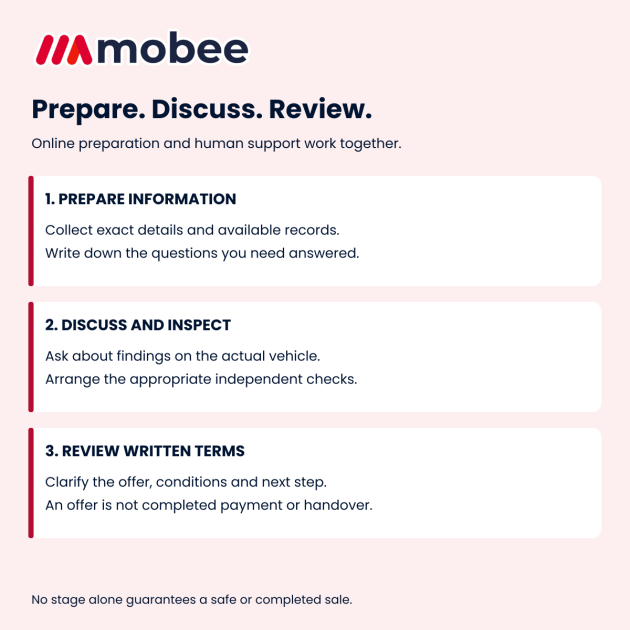
Three complementary stages: prepare information, discuss and inspect the actual car, then review the written terms. No stage alone guarantees a safe or completed sale.
1. Prepare information online
Gather the exact vehicle details, relevant photographs and available service records. Note the questions you need answered. Buyers can narrow their shortlist; sellers can describe known issues accurately before arranging an inspection. Avoid putting complete identity or ownership-document images into a public listing.
2. Use the meeting to resolve specific questions
Confirm who you are meeting and what the appointment covers. Bring your question list, compare the car with the information already supplied and ask for explanations of findings. Arrange the appropriate independent inspection when buying. Take time to understand an answer rather than treating attendance as a reason to commit.
3. Review the written outcome
Record the price or offer, its conditions, outstanding checks and the next agreed step. Distinguish an estimate from a confirmed offer, and an accepted offer from completed payment and handover. If a material detail is still unresolved, resolve it before proceeding.
Where Mobee Cars Philippines fits
Mobee Cars Philippines helps owners sell through a network of 300+ verified used-car dealers. Its seller process combines online submission with a free inspection and offers within hours after inspection, with no seller fees. An initial estimate is not a guaranteed final offer.
Use the inspection and customer-support conversation to understand the information being checked and the offer being presented. Confirm the arrangements for your vehicle; the timing of an offer is distinct from the completion of paperwork, payment and handover.
This seller service should not be confused with a general promise that Mobee has a particular retail car in stock or supplies an independent buyer’s inspection for every purchase. The buying guidance above applies to evaluating a vehicle wherever you choose to buy.
Start through Mobee Cars’ official channels, submit your car details or contact the team at +63 960 399 9990. Clear answers, supporting evidence and an informed decision are the useful outcomes of the conversation.
Reviewed on 27 October 2026. Survey findings retain their original dates and international scope; service arrangements remain subject to confirmation for the individual vehicle.
Was this article helpful?
How to Spot a Fake ORCR in the Philippines
17 April 2025 Mobee Cars PhilippinesVoluntarily Surrendering a Car to the Bank in the Philippines: What to Check First
17 May 2025 Mobee Cars PhilippinesHow to Check Flood-Prone Areas in the Philippines: Official Resources for Car Owners
15 November 2024 Mobee Cars PhilippinesNo comment yet. Be the first to comment.